I am most dreadfully attended – HAMLET, II ii

The blog has been dormant for the last week or so because it turns out Guildenstern (and honestly the entirety of Rosencrantz & Guildenstern Are Dead) is mentally exhausting. Who knew? To the point, in fact, where I was unable to chat with friends who came afterwards; the tip-of-the-tongue-the-teeth-the-lips, like a ballet dancer’s feet when unchoreographed, were accustomed to such Stoppard-enforced precision by the end of the night they couldn’t really do much articulating on their own. This seems to have continued over into having anything intelligent to say about the play – or anything that the play doesn’t say just fine on its own.

The pleasure came when the audience showed up – not that rehearsals weren’t fun, but the amount of legitimately hold-for-laughs comedy they mined out of it was even more, I think, than we anticipated. Or I may just have been so mired in learning the whole show over a period of months (memorization was a multi-front war, as it increasingly is with age/repertory, of highlighting, listening to myself recorded, writing it all out in unintelligible longhand, doing the dishes, etc., with a page or two of the script at hand to go over and over, pacing, mumbling, and of course actual rehearsals) that I couldn’t even be bothered to concern myself with how much the audience might respond to it.

It was nice to do for a modern audience we could still guarantee had some familiarity with Hamlet, many of them having seen Kentucky Shakespeare’s 2014 production. For instance: I consistently got a fair (cheap?) laugh with a slight pause – relative to the rest of the pauses in this script – after the second word of the line, “Words, words, they’re all we have to go on” which I thought would be at best a way-homer. There were others.

Unfortunately, I can’t seem to escape. Once I was solidly off book, I allowed myself time for some pleasure reading again and picked from my room-sized To Get Around To stack Kazuo Ishiguro’s recent The Buried Giant, a novel about, among other things, a mist of vague amnesia and attendant anxiety creeping across post-Arthurian England. It’s a lovely book but it’s rather cruelly played into one of the trickiest parts of R&G: the difficulty of remembering a ludicrous amount of very delicate, articulate, repetitive, nay, loop-prone lines, many of which are precisely about the characters’ lack of memory. Not a nice thing to do to oneself.

Then I started catching up on the New Yorkers I’ve left sitting about for a couple of months and opened the December 19/26 issue to find this Alan Burdick piece on the psychology of time, which would have been exactly the sort of thing I picked up a New Yorker to read were it not for having spent the last while trying to get the rhythm right on a line like:

          G: Yes, one must think of the future…

          R: It’s the normal thing.

          G: To have one. One is, after all, having it all the time…now…and now…and now…

          R: It could go on for ever. Well, not for ever, I suppose.

Those “nows” and more importantly their accompanying ellipses are a bear if you want them to sound non-contrived and therefore funny. (The effect was aided by the staging, which had Rosencrantz trying to sit down but startling a bit as each was said, so timing the line was a matter of keeping another actor’s left hip in my visual periphery.) So to pick up an article that quotes William James on the passage of the instant – “We tell it off in pulses…We say ‘now! now! now!’ or we count ‘more! more! more!’ as we feel it bud.” – is to relive something one is trying to clear one’s mind of to make room for the next show.

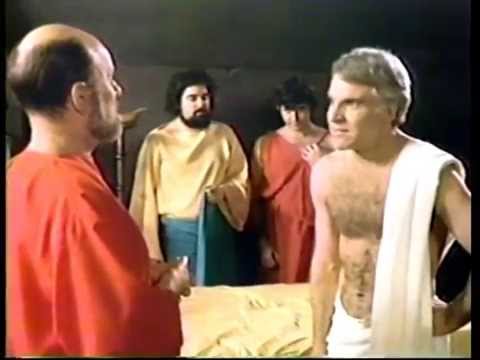
(I could have given James a hand here, honestly. The concept of time exists so punchlines land properly. Any other usage is tangential. Steve Martin once joked in Q&A form (G: “Question and answer. Old ways are the best ways”) that the perfect amount to pause for a punchline was “a second and a half”…which was how long he waited to answer that very question with that very answer. Had James, St. Augustine, and Burdick watched that special sixty or seventy times as a youth as I did – Comedy Is Not Pretty – they’d have had fewer such nagging questions. Though the show had more to say on Socrates than Augustine, I guess.)
This isn’t uncommon, this seeming attack from the outside by the very topic you have no particular intention of being obsessed with or consumed by but which seems to enjoy your company, which seems drawn to you like the disproportionate amounts of dust that surround electronic equipment at home while one is at rehearsal all the damn time. Or not uncommon to me, at least. 

But it does have a way of making one feel like Michael Corleone, as bememed above, is all.

O dainty duck, O dear! – MIDSUMMER, V i

Let me introduce you to my Patronus…

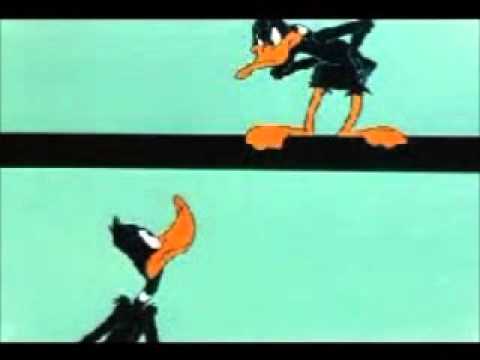
No doubt you are familiar with the Warner Brothers Merrie Melodies animated classic “Duck Amuck” (1953), written by Michael Maltese, voiced by Mel Blanc, scored by Carl Stalling, layed out by Maurice Noble (in some of his finest work this side of the 24 1/2 century) and directed by one of my primary (also prime and primal) artistic influences, Chuck Jones. (This post was very nearly titled “…dearest Chuck…” (Macbeth, III ii) instead, but Bottom won the toss.)

If you haven’t ever seen it, a) I envy the opportunity you’re about to get (though never miss a chance to see it on the big screen) and b) here it is, not in the best visual quality but still magical.

I’ll wait.

Now, as I’ve mentioned one hundred times in self-aggrandizing plug after plug, I’m playing Guildenstern next week in this stellar production of Stoppard’s classic. And what I’m going to suggest to you now, before I get buried in tech for several days and have to lay off the blog while I mumble my four thousand lines to myself for a couple of hours a day, is that the two aforementioned works are as spiritually analogous to each other as the latter is textually with Hamlet.

If you aren’t familiar with Rosencrantz & Guildenstern Are Dead, a) I envy the opportunity you’re about to get to see it on stage (if you’re within driving distance to Louisville, directions are at the link above – January 3-8, curtain times vary) and b) you could always read it, too.

I’ll wait.

I should note here that I’ve always been of the opinion that comedy, especially of the goofier sort, is always a few steps ahead of the avant garde. Beckett is a wonder and a favorite, but Spike Milligan, Peter Sellers, & Harry Secombe were pop stars doing the same thing on radio first, not to mention Laurel & Hardy. The following falls into that line of thought.

Now:

Rosencrantz & Guildenstern = Daffy split;

The Player = The Pencil/Brush;

Shakespeare = Bugs;

Chuck Jones, et al. = Stoppard.

Demolish.


Now to a few tedious work days of tech, then the relative sport of the playing holidays of performance. And then, as Silence drunkenly sang, “we shall

          doe nothing but eate,

          and make good cheere,

          and praise heaven for the merrie yeere” – Happy 2017, y’all!

Say, has our General met the enemy?–CORIOLANUS, I iv

Say, has our General met the enemy? - Coriolanus, I iv

It’s difficult to tell, the internet being what it is, whether we’ve really lost a disproportionate number of beloved cultural figures this year (though it sure seems true) or whether generationally some of them were statistically due (and were of a generation not particularly lauded for taking care of its physical health). And I am not a person who sits around contemplating mortality all the damned time – surviving surgery does put the thought in your head, but mostly it’s made me more determined to Do The Thing rather than spend my energy worrying about the undiscovered country.

That said, The Thing I’m currently Doing is Rosencrantz & Guildenstern Are You-Know-What, so even the simple act of running lines on what was apparently the darkest night in five hundred years this past Solstice means running into:

Let us keep things in proportion. Assume if you like that they’re going to kill him. Well, he is a man, he is mortal, death comes to us all, etc., and consequently he would have died anyway sooner or later. Or to look at it from the social point of view, he is but one man among many, the loss would be well within reason and convenience. And, then again, what is so terrible about death? As Socrates so philosophically put it, since we don’t know what death is, it is illogical to fear it. It might be…very nice. Certainly it is a relief from the burden of life and for the godly a haven and a reward. Or to look at it another way: we are little men, we don’t know the ins and outs of the matter, wheels within wheels, etc. It would be presumptuous of us to interfere with the designs of fate, or even kings.*


…so it’s hard, between work and Twitter, plus the added end of year In Memoriam habit (the best of the genre is always the “TCM Remembers” reel, which I highly recommend, and which I hope they don’t have to update yet again in the next few days; twice is enough), not to have such matter in mind in a year that has seemed kind of cruel even for friends and family, beyond the losses of so many observed-of-all-observers.

And of course I’m torn, as this centering chunk of Stoppard’s Guildenstern could be the admirable kind of stoicism or the other kind – since I’m also working on notations for Julius Caesar, let’s call it the “Brutus showing off how chill and balanced he is in front of his men when he’s already known Portia swallow’d fire for some time” kind. Or whistling, as Blue Valentine-era Tom Waits (and others) would have it, past the graveyard.

There is also the inveterate whinging kind of response – as soon as the Caesar notes are done, I move on to Richard II  and rather than quote a lengthy passage, let’s say starting about here and moving on until he’s actually dead, our title character has little else on his mind or lips. Ros & Guil have plenty of this as well. They cover most options, really.

(I am aware that I’m leaving out Hamlet’s famous contemplations, but honestly, he contemplates just everything, and were there another act nestled between One and Two, he’d have contemplated the recipes of those funeral baked meats and whether they were better hot or leftover. It’s hard to call death his only preoccupation – being preoccupied is his real preoccupation.)

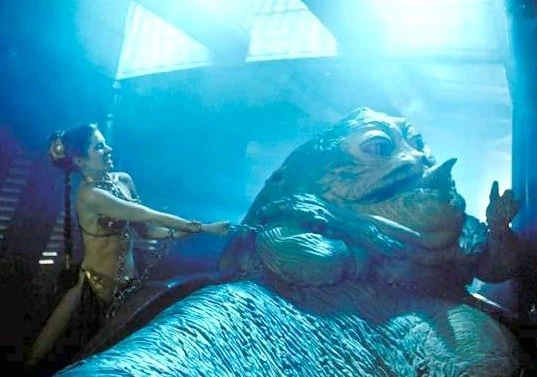
Now, my tendency is to mock…many things, mortality included – the Barely-Inner Groucho is my strongest force (oh, that word). Carrie Fisher’s death was made public a few hours ago, and one of my favorite things about her has always been this (in her case, notorious) B-IG.  It was the real source of her power, not the buns and the blasters and the (still disappointingly clinical) midichlorians.

When I played Feste a few years ago, I got to both sing/play and write a setting for the songs, including this one:

          Come away, come away death,

          And in sad cypresse let me be laide.

          Fye away, fie away breath,

          I am slaine by a faire cruell maide:

          My shrowd of white, stuck all with Yew, O prepare it.

          My part of death no one so true did share it.

          Not a flower, not a flower sweete

          On my blacke coffin, let there be strewne:

          Not a friend, not a friend greet

          My poore corpse, where my bones shall be throwne:

          A thousand thousand sighes to save, lay me ô where

          Sad true lover never find my grave, to weepe there.

…and the choice, what with Feste’s prime goal being survival via remuneration most of the time, when a self-involved ninny like Orsino makes a song request, is going to be the most maudlin (or if you’re reading this in England, Magdalene) thing imaginable. So I composed an ersatz Irish ballad fraught with Melodrame, limping along in 3/4 time, smacking “corpse” and “bones” and “grave” for maximum financial potential. It worked, in the scene at least.

My hope is that if nothing else makes it out of 2016 intact, the mockery will. I have yet to run across any Grand Force (there’s that word again) that cannot be deflated through the pokey pinpricks of laughter at its expense. We’re already seeing how this plays out with would-be human powers in other current affairs, but it certainly works against abstracts when apostrophizing. Or it hasn’t killed me yet, at least.

Fear no more the heat o’ the sun, Nor the furious winter’s rages…     


*Pardon any inaccurate punctuation – I’m working on these lines and I am NOT going to go find the script to check. If I don’t know that speech now, I certainly don’t want to know that I don’t.

So much as from occasion you may glean/ Whether aught to us unknown afflicts him thus – HAMLET, II ii

Like this blog, my Twitter account is not widely followed. Not that it should be – it’s mostly the semi-daily ramblings of a guy who cracks wise, follows comedians, & gets mildly-to-very outraged at various sociopolitical happenings. The only real upside for folks who follow me is a No Cat Video guarantee.

I have been, on fewer occasions than one needs a hand’s worth of fingers to count, retweeted by People of Note. One of those instances was a few days ago when I noted something during some light road trip playlisting and the band in question retweeted said observation, which resulted in a weird amount of strangers commenting/favoriting/retweeting and it’s all over now, this phenomenon of something in the neighborhood of twenty or thirty people noticing some damn fool thing I said.

Anyway, I promised to dig deeper into this blithe comment, and herein do I so dig.

En route to Florida, The Wife and I were listening to the 2015 They Might Be Giants album entitled Glean. I am, as I have mentioned here before, also in rehearsals for Stoppard’s Rosencrantz & Guildenstern Are Dead (from which we had a brief break for this pre-arranged trip). These two things are not related.

At least, they weren’t. But I listened too closely.

I will neither dignify this foolishness with a well-footnoted treatise nor any real claims that the band set out in its Dial-A-Song project to make a companion soundtrack to a fifty-year-old absurdist reimagining of Hamlet. But I feel compelled to share a few observations.

We’ll begin with the first track, “Erase”.

          You and I will be together

          When we shed our memory…

          Think of this as solving problems

          That should never have occurred

          Please don’t call it strangulation,

          That is such an ugly word…

          When darlings must be murdered…

          The skeleton that won’t stay down

          The mercy kill that can’t be drowned

If you’re at all familiar with the play (which I’m going to have to assume because I’m not going to try to summarize it and its themes here; I have too many lines to learn), this will stand out to you immediately. The title characters have constant short and long term memory loss, which causes them no end of consternation. Also (spoiler) they die, which also causes them consternation, though with an end in that case. They are themselves problems that should never have occurred, characters who exist for no real reason except perhaps to be one of Hamlet’s many proverbial women in refrigerators.


The second track, “Good to Be Alive” is even easier to apply. It’s about what the title would imply. So there you go. Think of it as an oblique version of Rosencrantz’s Act II speech about being dead in a box, favorite of college auditions for decades.


The third, “Underwater Woman”, can only now make you think of Ophelia:

           No one on the shore will ever know what’s in her heart…

           Laughing uncontrollably, who is she talking to?…

           Intently staring at a photograph…

           No one can tell when she cries…

Duh.


“Music Jail, Pt. 1 & 2”, I hear you cry? Clearly the musicians who, along with the tragedians, are implausibly stuck in barrels for the first half of Act III. Next.


“Answer”, a word with profound significance in R&G, is filled with images of surveillance and agents and spying (the very job Claude & Gert have hired them to do), and also features the quatrain:

           It might seem like a thankless existence

           But don’t lose hope just yet

           You’ll be remembered for your persistence

           And this is the thanks you get

Which is about half of the title characters’ lines in a (pardon)  nutshell. Though they’re more often in the form of a question. But when one is in jeopardy, what else can one expect?


“I Can Help the Next in Line” is a stretch, sure, but the line “Have you been with us in the past?” is not without import here. Also, the extended calling for “Next!” is something that happens repeatedly as R&G wait with increasing desperation for someone, anyone, to enter the stage.


“Madam, I Challenge You to a Duel” I take to be aimed at poor little Alfred, slave to the Player, that purveyor and perverter of “transvestite melodrama” and various over-wordy tales of swordplay, “full of fine cadence and corpses”.

           Such a lot of words

Yep.


“End of the Rope” – here we are back at strangulation imagery, and while beheading is more likely to be their fate, it should be noted that even the cover to the published version of the play includes a rope-as-ampersand in the title. Hanging is in no way too good for them.

           You’re gone, but I’m still there

           Clawing at the air

           Now it’s curtains for me

           And I’ll spend eternity

           Doing joyless cartwheels in the void…

is as close to Guildenstern’s last words as one is likely to encounter via serendipity (cf. the whole first scene of the play and its thoughts on coin-spinning and the laws of probability). And

           How dumb can you be?

is something Guildenstern asks Rosencrantz repeatedly in the form of “Are you stupid?”, “What’s the matter with you?”, and several other withering phrases.


“All the Lazy Boyfriends” is Hamlet’s song, I think.

           Who needs motivation when you live in your head?…

           Did you say out loud that you think you’ve lost your edge?

           Begin again, begin again…

(“What’s he doing?” “Talking.” “To himself?” “Yes.”

And furthermore, “”He might have had the edge.”

As well as the repeated variations on “practically starting from scratch…”)


The very first words of “Unpronounceable” are “Time stopped”, which is but one of Guildenstern’s theories on their plight as it relates to the constant heads-uppery of the coins they toss. But then we get to the meat…

           Your name it is unpronounceable

           Distorted and illegible

           I never figured out what that was…

(On trying to figure out which is named R and which G, after realizing no one can tell them apart, including themselves: “…people knew who I was and if they didn’t they asked and I told them.” “You did, the trouble is, each of them is…plausible, without being instinctive.” They never do figure out what that was, not with real certainty, even with only two to choose from.)


The wordplay and poetic lic-/nons-ense of “Hate the Villanelle” works more as a tribute to both this play and its verse-laden source material. “Words, words, they’re all we have to go on.”


Though at first I was thinking of “I’m a Coward” as another Hamlet song, pulled right out of the “rogue and peasant slave” speech, it quickly became more Stoppardian via Laurel and Hardy or Abbot and Costello or whichever duo you think these two most resemble.

           I need a confidant

           A co-conspirator

           To turn the tide

           On my losing side…


“Aaa” is about unpleasant surprises of the sort that result in both physical and existential danger, with lots of screaming. Ditto R&G.

           And what am I made of?

           I’m gonna find out now

           Aaa!

           Aaa!

           Aaa!


“Let Me Tell You About My Operation” is about a procedure in which

           Doctors removed your memory

tying back into the constant memory loss (“We cross our bridges when we come to them and burn them behind us, with nothing to show for our progress except a memory of the smell of smoke, and the presumption that once our eyes watered.” I am so incredibly proud to have typed that from memory right now, because getting off book for this damned show is slowly killing me.)

More importantly, this song provides the only reference to Stoppard’s other obvious source material, Beckett’s Waiting for Godot, which I am not currently memorizing but still know a “tray bong” when I hear it.


Which brings us to the final and title track, the instrumental “Glean”, which is a word I say seventy damned times in this show, almost as much as the actor playing Rosencrantz says “heads”. I don’t know that we ever do quite “glean what afflicts him” beyond the profoundly obvious, because we’re too afflicted ourselves to solve that pampered mutterers problems, regardless of his uncledad’s potential financial generosity.


That’s it. That’s too much. That’s enough. That’s all.

I pray you remember the Porter. – MACBETH, II iii

Look, I must get back to doing some footnoting and pronunciating for Kentucky Shakespeare’s summer season. I’ve been busily & desperately trying to get Guildenstern’s lines into my addled and aging brain which has delayed my dramaturgerery for a spell. There are new old plays to work on, so I need to put the old old plays to bed for a bit.

But I have one last thought on my roughly twenty month on/off sojourn in Mostly Fictional Scotland.

People cut the Porter. And when they don’t cut him entirely, they trim him down mercilessly*, especially considering the shortness of Macbeth to begin with. And I get it. No one knows what equivocation means, and if they do, they don’t much care. (Nowadays, we just outright lie, which seems to get the job done for a lot of people; Jesuit-era shenanigans seem almost quaint.) I’ve been in a production without him; I’ve been in a production with little of him; I’ve been in a production where I was him. And very few people mind it when he’s gone.

I’m here to say a word for him.

Penis.

Yeah, that’s the word.

Dick jokes in Shakespeare get a bad rap, primarily because actors are under the impression that no one in the audience ever knows what they’re talking about and therefore feel the desperate need to point eternally towards their junk. Every. Single. Time. There’s a dick joke in the text.

I say, demand, plead, now to those actors: please don’t do that. Please. I get that a lot of you signed on to Shakespeare under the mistaken notion that the tragedies are the real classics and are therefore not all constitutionally equipped for comedy. But I swear to you if the audience understands nothing else you’re saying, they hear those. They get those. They make up their own in places where they may or may not be. We are a culture of nine-year-olds and we may miss political machinations (real or fictional) or relationship nuances ( r or f), but everybody knows a dick joke when it happens. Don’t Point To Your Crotch. Make literally almost any other choice but that. I’ve known some bawdy people in my life, but none of them ever underlined a dick joke by pointing to one. That’s not how good jokes work.

And audiences: stop blaming Shakespeare. Blame the actors. Don’t let them do that. Bring old veggies if you must. Whatever stops this.

Where was I?

Right. Standing up* for the Porter.

In a play about succession and male children and who gets dad’s job when he’s gone and who even has a son to begin with, it’s hard for me to agree that the Lecherie Routine is irrelevant. We’ve already established that Lady M. lost a child at some point, that Banquo’s issue Fleance is a threat constantly present in Macbeth’s filed mind, that “man of woman born” is not a phrase to be taken lightly. Duncan has already o’erleaped the usual protocol and said, “You know what? You’re all great at your jobs but I’m handing all this to my kid when I’m gone.” Whether or not the family jewels are in working order comes up a lot.* Especially for men who do battle in nothing but kilts.

And it’s not like the Porter is the only one who brings this up.* Mr. Fancy Tragic Star Himself notes that the witches in prophesying Fleance’s inheritance have “put a barren sceptre in [his] grip”.  Even Freud probably thought that a bit much. And I’ve always been convinced there’s a barely-veiled offer going on in Lady M’s “and you shall put/ This [k]night’s great business into my dispatch” – he is rather easily led around*, isn’t he?

She’s prone to taking this to places we Still-(Still?!)-Post-Victorians aren’t comfortable with, too. After all, just before his entrance,* she was going on very un-bawdily about her own Lady (M.) Parts, what with all that begging the Spirits to

                                              …make thick my blood,

         Stop up th’accesse, and passage to Remorse,

          That no compunctious visitings of Nature

          Shake my fell purpose…

Plus her eventual (and frequent) introduction of the topic of nursing, which bounces around to some other folks too before all is done.

(Performance* Digression: We had to cut a lot of those for the student tour version I was in. Not because it would offend some puritans so much as because there’s nothing so disheartening at 9:00 a.m. as seeing the dead eyes of fifteen-year-olds aggressively ignoring you until “woman’s breasts” wakes them enough to make them snort for ten minutes. I add here with pride that my wife’s Lady M. during those shows kept all of

                                           I have given Sucke, and know

           How tender ’tis to love the Babe that milkes me,

           I would, while it was smyling in my Face,

          Have pluckt my Nipple from his Bonelesse Gummes,

          And dasht the Braines out, had I so sworne

          As you have done to this.

She so grossed them out and terrified them with the image and its coiner that neither “nipple” nor “suck” got a single laugh that whole tour. Take that, Adolescence.)

(Second Performance* Digression: I was also proud of how we handled the Lecherie Routine in the production in which I was the Porter, which was that neither Macduff nor his gang thought a single bit of it was funny, which explained why it went on so long – the Porter wasn’t going to let it go until he got a laugh. And all he got, after eleventy repetitions, was “Is thy master stirring?”* as if to say “Is there someone else up there we could talk to?”


The Porter doesn’t answer. I just shrugged and left the humorless jerks. Fortunately, Maccers came down right after. Their problem now.)

(Comedy Digression after Second Performance* Digression: There are solid and underappreciated non-dick laugh lines throughout Macbeth. In all three productions, occasional-to-consistent laughs came: at the Doctor’s “Will she go now to bed” after sleepwalking Lady M’s “To bed, to bed, to bed”; Macbeth’s own understated “’Twas a rough night”; and often at the ur-Schwarzenegger kill quip “Thou wast born of woman” when (spoiler) Young Seyward goes down*.  I always had a hankering to do a commedia production with the text unchanged, mostly so I could cast Punch & Judy as the Macduffs – when he keeps asking for repeated confirmation that his awful family is dead it’s because it sounds too good to be true.)

It’s not just the Porter, is all I’m saying. It’s a penis-ey, vagina-ey play. And not in a “Will* was male and we can’t go too long* without mentioning it” way, but in an “inherent to the lines of story and succession” way. The vitals are vital.

That’s it. That’s my defense. I pray you, remember. The randiness is all.

(Final Digression: I keep threatening to use my meditative needlecraft hobby to make my Scotch-derived wife (though that blood has undergone a full bourbon transfusion since I moved her here) a bed-coat with her clan tartan on it purely because there’s a “sleep, that knits up the raveled sleeve of Kerr” line in there somewhere. But I’m having a beer as I type this, so I’m placing all the blame there.)


*I’m just going to put an asterisk next to any unwitting potential dick joke/reference as I go back through this.

The mere despair of surgery, he cures – MACBETH, IV iii

I add nothing to the current human conversation when I note that much of 2016 was thoroughly rotten, unsettling, cruel, and relentless. I’ve even started a list for myself to keep my memory of it in some sort of balance – the Cubs won; I got a surprise last minute first row chance to see Springsteen again; some of my favorite people on the planet had a healthy baby; our young nieces are memorizing Hamilton and leaping headfirst into DC comics and Agatha Christie; our teen nephews are aging rapidly, settling nicely into their personal freak flags, and asking all the right questions about Dr. Strangelove; my wife and I have played Olivia/Malvolio, Speed/Launce, and started in on a new set of song for our music duo; the Tavern re-opened after an overlong arson-based hiatus.

I save two things for last. I’m not very good at Stillness, and if my body is, my mind ain’t. One or both are always moving. So the time my body forced me to spend recuperating after the glorious surgery in mid-March, after which the innards were dandy but the muscles that usually protect said innards had to spend a lot of time engirded and, yes, still, was necessary but ohgoodgoddifficult. And while I’m anything but a bodybuilder, I was almost constantly weak and quivery in an unpleasant way I hid from most people.

But in August, after an international trip and a three-month outdoor performance gig (which you’d think would be enough proof of recovery, tough though it was), the gem of my summer was reaching The Rock out in the lake when we visited my in-laws.* It’s the thing one swims to when one goes to that lake. Because it’s there. Just far enough out to be worth going to, but not really tiring. Nice quiet place to sit (barring interference from the inevitable speedboating jackass, but they’ve been around since well before 2016). I wasn’t sure if I’d be making it to The Rock this year.

I made it to The Rock.

multiviewold

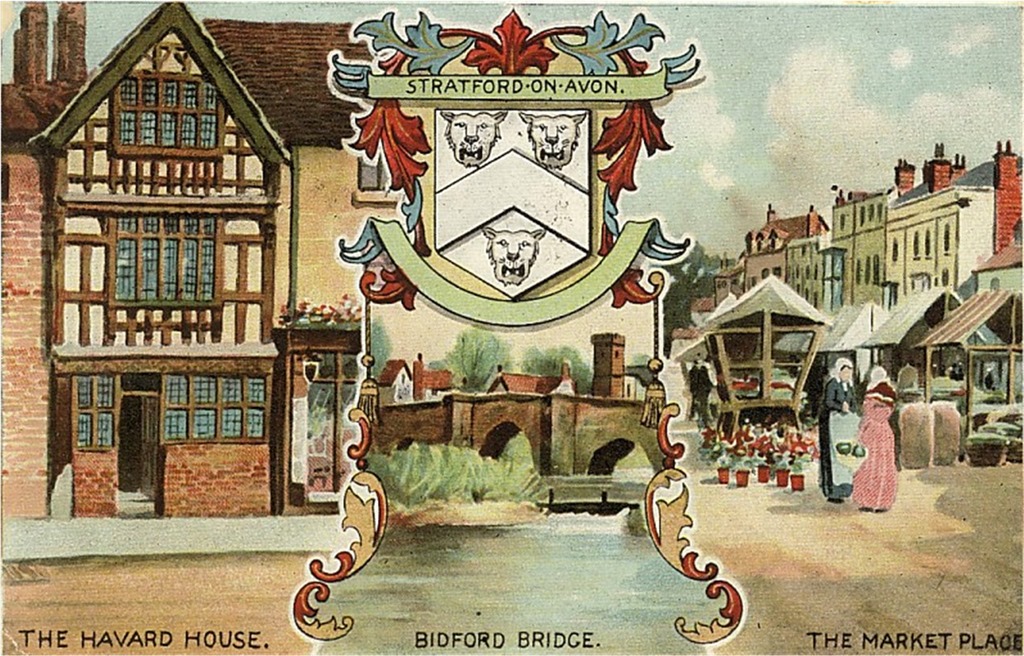
For the second thing, I direct your attention back to that international trip I mentioned both above and here. The Stratford Trip. Just in time for the quadricentennial of Shakespeare’s death (probably, -ish) and his 452nd birthday (-ish, probably), Kentucky Shakespeare took a tiny contingent over to be part of the festivities. And as things that I’ll try to remember about this year when posterity marks it as the time many great people and nations died, this trip will rank highest.

For starters, I got to be Shakespeare Himself (sort of, –ish) bright and sweetsweetMoses early on the BBC’s kickoff to the 23 April festivities as there in slightly muddy and as-yet-unopened New Place (though they did let Prince Charles in later that afternoon, so now I suppose anyone can enter) four of us did a variation on the house blessing scene from A Midsummer Night’s Dream live on national(ized) television. That was terrifying after the fact.

Then we had an opportunity to perform some scenes in the courtyard of the birthplace proper, which while not widely recognized as a performance space has a fascinating vibe when used as one. It was touch and go for a moment there when my wife-as-Kate faux-kneed me-as-Petruchio-with-a-“ch”-thank-you in the groin (as planned) and I dropped to my knees, which takes a bit more abdominal strength than I was ready for, but the day was saved by the power of the muscle-tightening and quite slimming girdle under my doublet. We acquitted ourselves well enough, I guess, that two locals said afterwards, “They were quite good! Despite the accents!” to our (also American) friend and artistic director, who smiled and nodded so as not to betray his own accent to them.

Also, I touched a Folio.

There’s a First Folio floating through town right now, at Louisville’s Frazier History Museum. We went to see it (and some Shaker furniture and a Prohibition exhibit and the dresses from the “Sisters” number in White Christmas – there’s a lot going on there) with my folks last week and it was fun to see their reactions…but I had touched one.

You see, down in the vaults beneath the Shakespeare Birthplace Trust (and its research facility, at which I got to browse through Bram Stoker’s old Irving/Terry playbills and the prompt books from the RSC’s Barton-era Wars of the Roses which made my fingertips tingle a bit with impertinence), we were shown some fancy and ancient tomes, your Holinsheds and your Plutarchs and your medical treatises of the era and whatnot, and I poked an aforementioned emboldened fingertip at a spine and said, “And what’s this one?”

“Oh, that’s a Folio.”

Now had this been one of my average days, my recoil, which was significant and covered no little ground, would have sent me backwards into a seven-foot plinth atop which was a bust of antiquity which would fall into my arms after I danced about trying to keep it from becoming a bust, full-stop. But the spirit of Buster Keaton kept his distance and all that fell through the air was a high-pitched “Eep!” from me.

But the covers of Folios are well known for being not-particularly-valuable, relatively, and no one seemed terribly upset by it, myself excluded. We had scrimped for the part of the trip we were responsible for, but an irreplaceable volume wasn’t in the budget.

Then a week in Bath, just us two (my wife, not the Folio), then home for more of 2016, ptui.

Thirty-two more days and counting.

(A quick note: I always grouse about quotes out of context, especially when I’m the guilty party. So I’ll note that this post’s headline is (clearly) not about Shakespeare as I imply but about the healing (?) hands of King Edward the Confessor, as spoken by Malcolm in that English Doctor mini-scene everyone cuts, and I didn’t have scrofula anyway, but an intestinal complaint. I also can’t help but note sadly here that we’re not very likely to get aid from England these days in dealing with our own impending tyrant, who is practically on his way to Scone, whatever you choose to rhyme it with, as we sit, what with England having its own non-scrofular troubles at the moment.)

*My in-laws don’t live in the lake. Just near.

March on, and mark King Richard how he looks. – RICHARD II, III iii

A couple of weeks ago, I taught this Shakespeare workshop – co-taught, really, but the other honcho was focused on audition skills and my area was verse and especially picking meaning out of the Folio – and I have to say, despite my dismal history as an instructor (I can count on Harold Lloyd’s right hand the times I’ve really enjoyed it or felt like I should be the one doing it), I had a ball. The opportunity to geek out with a group of people who asked for it is a pleasure.

I remembered only after the fact why I brought up the idea of this workshop in the first place, or at least what made the nickel drop and remind me that I feel strongly about contributing to this particular kind of conversation with actors: one line.

Not even a line. A turnaround between two lines of verse. There’s this moment in Act III, Scene iii, around the middle of Richard II where Bullingbrooke is about to show off the size of his not-quite-yet-rebelling forces to Richard, who is above peeking out a castle window. Bullingbrooke ponders how their impending parley might go.

          Me thinkes King Richard and my selfe should meet

          With no lesse terror then the Elements

           Of Fire and Water…


Then a whole scientifically dubious thing about how fire and water make lightning which isn’t important to this discussion. Then:

         Be he the fire, Ile be the yeelding Water;

          The Rage be his, while on the Earth I raine

          My Waters on the Earth, and not on him.


Now, were this not in verse (and Richard II is written entirely in verse, which is uncommon for Shakespeare), that phrase would read:

          The Rage be his, while on the Earth I raine my Waters on the Earth, and not on him.


Sure, fine. But it is in verse, and the line break is there, and it is dancing on the edge of treason. Spelling is dicey enough in this era, but pronunciation here is important.

          The Rage be his, while on the Earth I raine…

…a pause, pregnant, or playful, or threatening – does he mean “reign”? Because this speech is full of tricky stuff to talk about right here with Richard the Still Actual King nearby. Not to mention that even if the listener hears the less threatening “rain”, Bullingbrooke has said seconds before that if Richard will un-banish him and give him back the inheritance that was absconded with to help pay for an Irish campaign, he’ll say thank you and move on:

          If not, Ile use th’advantage of my Power,

          And lay the Summers dust with showers of blood,

          Rayn’d from the wounds of slaughter’d Englishmen;


There’s about a fifteen line distance between that equating of rain with battle-shed blood and the next use of the word. So again, even if Bullingbrooke means “rain” and not “reign”, it’s dancing on the border of Ain’t Good. Where was he? Ah, yes:

          The Rage be his, while on the Earth I raine […tick tock tick tock…]

          My Waters […why? What did you think I meant?] on the Earth, and not on him.


And yes, I have spent all this precious time on a homophone that anyone can see and hear easily. But it’s the one I remember reading and thinking that if the actor doesn’t deal with the verse as it is and just reads the sentence, well…in this instance, the character and the moment change significantly. Not the hinge of an entire play, not some revelation of Whodunnit or Why, but still a moment that ought to be attended to.

I didn’t bring this example up in the workshop, but plenty of other things came up, so all is well. My next devious plan is to try to put together a similar workshop for non-actors, meant for those who would like to read this stuff in the convenience of home but can’t because it makes for dreadful reading…unless…

Shall I be frighted when a madman stares? – JULIUS CAESAR, IV iii

All right. Back to this stuff.

death-of-julius-caesar

I’m working on a pronunciation guide/glossary for our production of Julius Caesar and remembering the last time I saw a really effective production. I visited London in 1999 and paid my groundling pound to see it at the Globe. I went in with the same feeling many Americans who went to public school have about it, which is to say I was forced to read it by someone who I can only assume desperately wanted me to hate it because wow was it dull and forbidding.

I’ve since been told that one of the reasons Julius Caesar has been such an academic mainstay for so many years in our Puritan-founded nation (remember them? The ones who closed theatres in the first place?) is that unlike Macbeth, Romeo & Juliet, and just about all of the other biggies, there is zero hanky panky; none of filthy flirting and cheap puns about genitalia that admittedly don’t play as well now as they must have done once but would certainly garner a 14-year-old’s attention more than the two possible allusions to sex in JC: the title character’s cheap dig at his wife’s infertility and Portia’s use of the word “harlot” (though she also says the word “sex”, always a distraction to The Youth even when it means gender as it does in her case). That’s it. No booze-flaccid Porter, no Folger footnote about what “nothing” could occasionally mean. No fun.

But it was what was playing and I wasn’t going to miss seeing a show at this space I couldn’t just walk down the road to every day.* So I saw this traditional (Elizabethan, all-male company, pumpkin-pants-and-toga-pieces) Julius Caesar, set on a bare stage with a bench and a potted fern, with the only modern dress given to the Plebians at the top and around the middle (of the play, not of their wardrobes). And it was fast and it was exciting and there was comedy and there was storytelling and there was an intermission about every thirty minutes and I ate a bag of nuts and leaned my right elbow against downstage left for most of it and I loved it.

And not because of anything they did, but just because of the story, my mind kept banking the play off of the Kenneth Starr madness my own country was enmeshed in, the impeachment of a president not because of any particular policy or ability to govern but because there were people in said government who didn’t like him and who decided character assassination was the best way to distract from what was really happening, which was that they didn’t like not being in charge themselves. Which was causing rather a mess for the people on both sides of that equation who were just trying to live their lives in a country.

Which seemed, you know, Roman. Or Scottish. Or wherever any of about a dozen (minimum) works of Shakespeare take place when their conversations turns toward the unholy mess that follows whenever there’s a non-peaceful transfer of power, regardless of whether it’s a good idea or not.

So look out for a lot of productions of the Histories, of Caesar, Macbeth, Lear, etc., coming up very soon being described both positively and negatively as “political” as if just by telling those stories they had any choice.


*UTTER DIGRESSION: I’m fascinated by all the recent Emma Rice controversy, whether you put the emphasis on the first or the second syllable. People keep asking me my opinion of it as if I’ve ever had the opportunity to see one of her pieces. I live in Kentucky. I have not. In April I did see a little chunk of a rehearsal of this Midsummer that everyone’s so on about and I admit I noticed the amplification and lights and thought, “Oh. That seems to be missing the point of this house.” Not “How dare she swap genders and use modern dress and set pieces”, which surely people are used to by now – though I was in the gallery and the big tree balloon thingies were a definite sightline problem even for the short time I was there – but the insistence on amplifying the actors seemed like kind of a waste. If you can’t be groundbreaking and also acoustic in an acoustically astounding place, then you’re not trying as hard as you think you are. And if amplification is still “groundbreaking” I must have read my calendar wrong this morning. I also couldn’t help but notice that the gender parity that’s such a part of Rice’s mission seemed to involve giving two of the plum female roles to men (one a drag performer, one just male) and letting most of the Mechanicals (though not Bottom) be women, a lateral move at best. I understand that making the fairies sexually ambiguous is a fine choice as is making one of the young couples a pair of same sex (that word again) lovers, but that seems like a choice about story, not about casting parity. I don’t know many women who would trade playing Titania for playing Snug. END OF DIGRESSION.

You taught me language and my profit on’t/ Is, I know how to curse. – TEMPEST, I ii

Must go dig out the extra-large thermos. The debate is settled, the sweaters are out, and in the morning, bright and early (though not so early as it could be thanks to the outmoded but welcome tweaks of Daylight Savings), I’ll be teaching a Dealing with Verse in Shakespeare workshop to a bunch of unsuspecting actors. I’m looking forward to it, in part because I love the opportunity to practice my brand of geek evangelism. But like all evangelists, I’ll be in danger of crossing over into zealot territory, try as I might to rein it in.

I am in many ways a terrible, cruel, unfeeling person when it comes to The Good Of The Show; my concern for the emotions and often the needs of others and self almost always comes after TGOTS (or what I diagnose as falling into that category) which sits poorly with my non-confrontational tendencies and my deeply held but spottily obeyed belief that nothing is so important as to really freak out about it. One of these days I’ll figure out how to surf the balance between wielding a Buddhist’s calm and a nun’s knuckle ruler. Probably. Maybe. Back to Stoppard:

          Guildenstern: Do I contradict myself?

          Rosencrantz: I can’t remember.

It happens onstage sometimes, this balance, but less frequently off it. Which is why actors behave the way they do offstage, I expect (insert cocktail emoji), as well as why Chazz Palminteri shot Jennifer Tilly, though I’ve never taken it that far except in my mind. At least once a production, but still.

But since I’ve been digging through Richard II, living with my contradictions is a little less tricky…

          …For no thought is contented. The better sort,

          As thoughts of things Divine, are intermixt

          With scruples, and do set the word it selfe

          Against the word, as thus: ‘Come litle ones’: & then again,

          ‘It is as hard to come, as for a Camell

          To thred the posterne of a Needle’s eye’.

Except that’s not what the Folio says, now that I think of it, what with the “Don’t Say The Name of Our Lord Or Anything Too Sacrilegious On Stage You Repulsive Little Actors”  Puritan Bullshit Act of 1606 making it illegal to say “the word” in the context of “Bible stuff”. No, unlike the 1597 Quarto, the 1623 Folio says, with my emphasis,

         …and do set the Faith it selfe

          Against the Faith: as thus: Come litle ones…

Which someone felt was better (?). Odd that what may be the two most famous lines from Richard II, this and “For [God’s? Heaven’s?] sake let us sit upon the ground…”, are both affected by this.

Also the punctuation’s a little different, as if to remind me to go lightly on the Folio Zealotry mentioned above since the Folio is every bit as inconsistent as the Bible Richard of Bordeaux is musing on about.

Also, Shakespeare’s use of antithesis will figure into the workshop prominently, so the old actor chestnut of setting the word itself against the word is every bit as likely to come up as suiting the action to the word, the word to the action, so .

Also Richard is murderèd about five minutes later, assuming the pace of the Visiting Groom section doesn’t get too melodramatic. So maybe I’m taking the wrong lesson away from here altogether.

Now, where is that thermos?

Screw your courage to the sticking place – MACBETH I vii (and also HAMILTON)

Today I’ve been working on my Stoppard’s Guildenstern lines, ridiculous both in content and in number, as well as continuing to annotate Julius Caesar. I have foreseen, theatre people being what they are, a problem.

That problem is in the fourth scene of the fifth act of Julius Caesar, in which 1st Soldier anticipates the entrance of Marc Antony with the phrase:

          Heere comes the Generall

…which will make everyone break into “Right Hand Man” from Hamilton at the first table read and will never stop backstage until closing. Never. There will be no lull, even during tech. Because, as I said, theatre people are what they are.

The other problem is my own, which is the following exchange from the middle of R&G are D:

          Rosencrantz: (peevish) Never a moment’s peace! In and out, on and off, they’re coming at us from all sides.

          Guildenstern: You’re never satisfied.

For I, too, am a theatre people.

I take heart in knowing that when I’m trying to convince everyone of the vital importance of Folio punctuation during this workshop I’m leading on Sunday (and any other time the subject arises), I can freely use the example from “Take a Break” (which is what I’m really quoting in the post title) in which Angelica notices

          a comma in the middle of a phrase.

          It changed the meaning. Did you intend this?

          One stroke and you’ve consumed my waking days.

And if it’s enough to preoccupy Angelica, it might be taken seriously. Because, as I believe I have noted, theatre people are. What they are.