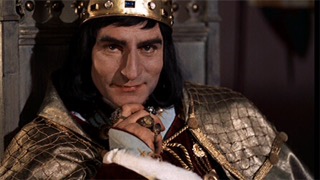
…as jealous as a turkey… – TWO NOBLE KINSMEN, II ii

What the hell does that mean? This is one of those times when it’s worth remembering that words keep changing. It’s bad enough when acting Shakespeare that one has to look up all the many unfamiliar words and idioms; it’s even possible to be betrayed by familiar ones. “Jealous” was more in the neighborhood of “suspicious” in the Elizabethan/Jacobean eras. So the wife of the First Countryman in The Two Noble Kinsmen would be as suspicious as a turkey. Which makes much, much more sense.

Gobble, gobble.

A beast, no more. – HAMLET, IV iv

I haven’t posted on here all week, what with feelings of utter existential futility that ensue when decisions feel like they’re out of your hands frankly not being conducive to having any impulse to dribble forth fleeting notions about how verse works and whatnot. I’ve instead spent the week getting a couple of projects going that I hope are a way to address goings-on in a way that’s some combination of useful to the world and what I know how to do anyway. I’ve also done a bit of stress eating as well as tried to get a few decent nights’ sleep, which as a person who just came out of a production of Macbeth in general and in specific an occasional knitter of sleeves myself, I know the good of.

Then I went to the Louisville Free Public Library last night to hear the University of Louisville Phi Beta Kappa lecture by James Shapiro, author of a bunch of very good and eminently readable books on the world surrounding Shakespeare. I’d had tickets to this lecture, entitled “Shakespeare in America”, for a while and it was clearly planned months before, so I was surprised by how immediately (and intentionally) relevant to events of the past week it all was. Despite the bubbles we all find ourselves in, Shakespeare will not allow himself to be one of them and when you try to make this happen, something unexpectedly relevant always pops its head out and squints in the bright light.

So rather than thinking of myself as a nerd wiggling punctuation around, I remembered (at my wife’s urging) that I’m also someone who right now is supposed to be poring over a trio of scripts, one a story of how people try to break out of a cycle of misogyny, one about one leader being supplanted by another in ways that make them both look dubious, and one about the disastrous effects of a small group of people setting themselves up as judge, jury and executioner of a leader even when they firmly believe they’re doing the right thing. I’m also someone who will soon be jumping around in front of people trying to tell a second-hand Shakespearean story of the feelings of utter existential futility that ensue when decisions feel like they’re out of your hands.

So nothing is irrelevant. None of this is a waste of time. And frankly, only about twenty people are reading this thing anyway, so neither am I significantly wasting anyone else’s time (feel free to share this blog, by the way. Thanks).

As stated, I’m mostly a Folio guy, but times like these sometimes make us have to dip into the Quartos, so:

                               What is a man

          If his chiefe good and market of his time

         Be but to sleepe and feede[?]

Don’t read the rest of that speech looking for too much more significance; I don’t have any treasonous plans – just a bit of rediscovered resolve.

Shall I be frighted when a madman stares? – JULIUS CAESAR, IV iii

All right. Back to this stuff.

death-of-julius-caesar

I’m working on a pronunciation guide/glossary for our production of Julius Caesar and remembering the last time I saw a really effective production. I visited London in 1999 and paid my groundling pound to see it at the Globe. I went in with the same feeling many Americans who went to public school have about it, which is to say I was forced to read it by someone who I can only assume desperately wanted me to hate it because wow was it dull and forbidding.

I’ve since been told that one of the reasons Julius Caesar has been such an academic mainstay for so many years in our Puritan-founded nation (remember them? The ones who closed theatres in the first place?) is that unlike Macbeth, Romeo & Juliet, and just about all of the other biggies, there is zero hanky panky; none of filthy flirting and cheap puns about genitalia that admittedly don’t play as well now as they must have done once but would certainly garner a 14-year-old’s attention more than the two possible allusions to sex in JC: the title character’s cheap dig at his wife’s infertility and Portia’s use of the word “harlot” (though she also says the word “sex”, always a distraction to The Youth even when it means gender as it does in her case). That’s it. No booze-flaccid Porter, no Folger footnote about what “nothing” could occasionally mean. No fun.

But it was what was playing and I wasn’t going to miss seeing a show at this space I couldn’t just walk down the road to every day.* So I saw this traditional (Elizabethan, all-male company, pumpkin-pants-and-toga-pieces) Julius Caesar, set on a bare stage with a bench and a potted fern, with the only modern dress given to the Plebians at the top and around the middle (of the play, not of their wardrobes). And it was fast and it was exciting and there was comedy and there was storytelling and there was an intermission about every thirty minutes and I ate a bag of nuts and leaned my right elbow against downstage left for most of it and I loved it.

And not because of anything they did, but just because of the story, my mind kept banking the play off of the Kenneth Starr madness my own country was enmeshed in, the impeachment of a president not because of any particular policy or ability to govern but because there were people in said government who didn’t like him and who decided character assassination was the best way to distract from what was really happening, which was that they didn’t like not being in charge themselves. Which was causing rather a mess for the people on both sides of that equation who were just trying to live their lives in a country.

Which seemed, you know, Roman. Or Scottish. Or wherever any of about a dozen (minimum) works of Shakespeare take place when their conversations turns toward the unholy mess that follows whenever there’s a non-peaceful transfer of power, regardless of whether it’s a good idea or not.

So look out for a lot of productions of the Histories, of Caesar, Macbeth, Lear, etc., coming up very soon being described both positively and negatively as “political” as if just by telling those stories they had any choice.


*UTTER DIGRESSION: I’m fascinated by all the recent Emma Rice controversy, whether you put the emphasis on the first or the second syllable. People keep asking me my opinion of it as if I’ve ever had the opportunity to see one of her pieces. I live in Kentucky. I have not. In April I did see a little chunk of a rehearsal of this Midsummer that everyone’s so on about and I admit I noticed the amplification and lights and thought, “Oh. That seems to be missing the point of this house.” Not “How dare she swap genders and use modern dress and set pieces”, which surely people are used to by now – though I was in the gallery and the big tree balloon thingies were a definite sightline problem even for the short time I was there – but the insistence on amplifying the actors seemed like kind of a waste. If you can’t be groundbreaking and also acoustic in an acoustically astounding place, then you’re not trying as hard as you think you are. And if amplification is still “groundbreaking” I must have read my calendar wrong this morning. I also couldn’t help but notice that the gender parity that’s such a part of Rice’s mission seemed to involve giving two of the plum female roles to men (one a drag performer, one just male) and letting most of the Mechanicals (though not Bottom) be women, a lateral move at best. I understand that making the fairies sexually ambiguous is a fine choice as is making one of the young couples a pair of same sex (that word again) lovers, but that seems like a choice about story, not about casting parity. I don’t know many women who would trade playing Titania for playing Snug. END OF DIGRESSION.

You taught me language and my profit on’t/ Is, I know how to curse. – TEMPEST, I ii

Must go dig out the extra-large thermos. The debate is settled, the sweaters are out, and in the morning, bright and early (though not so early as it could be thanks to the outmoded but welcome tweaks of Daylight Savings), I’ll be teaching a Dealing with Verse in Shakespeare workshop to a bunch of unsuspecting actors. I’m looking forward to it, in part because I love the opportunity to practice my brand of geek evangelism. But like all evangelists, I’ll be in danger of crossing over into zealot territory, try as I might to rein it in.

I am in many ways a terrible, cruel, unfeeling person when it comes to The Good Of The Show; my concern for the emotions and often the needs of others and self almost always comes after TGOTS (or what I diagnose as falling into that category) which sits poorly with my non-confrontational tendencies and my deeply held but spottily obeyed belief that nothing is so important as to really freak out about it. One of these days I’ll figure out how to surf the balance between wielding a Buddhist’s calm and a nun’s knuckle ruler. Probably. Maybe. Back to Stoppard:

          Guildenstern: Do I contradict myself?

          Rosencrantz: I can’t remember.

It happens onstage sometimes, this balance, but less frequently off it. Which is why actors behave the way they do offstage, I expect (insert cocktail emoji), as well as why Chazz Palminteri shot Jennifer Tilly, though I’ve never taken it that far except in my mind. At least once a production, but still.

But since I’ve been digging through Richard II, living with my contradictions is a little less tricky…

          …For no thought is contented. The better sort,

          As thoughts of things Divine, are intermixt

          With scruples, and do set the word it selfe

          Against the word, as thus: ‘Come litle ones’: & then again,

          ‘It is as hard to come, as for a Camell

          To thred the posterne of a Needle’s eye’.

Except that’s not what the Folio says, now that I think of it, what with the “Don’t Say The Name of Our Lord Or Anything Too Sacrilegious On Stage You Repulsive Little Actors”  Puritan Bullshit Act of 1606 making it illegal to say “the word” in the context of “Bible stuff”. No, unlike the 1597 Quarto, the 1623 Folio says, with my emphasis,

         …and do set the Faith it selfe

          Against the Faith: as thus: Come litle ones…

Which someone felt was better (?). Odd that what may be the two most famous lines from Richard II, this and “For [God’s? Heaven’s?] sake let us sit upon the ground…”, are both affected by this.

Also the punctuation’s a little different, as if to remind me to go lightly on the Folio Zealotry mentioned above since the Folio is every bit as inconsistent as the Bible Richard of Bordeaux is musing on about.

Also, Shakespeare’s use of antithesis will figure into the workshop prominently, so the old actor chestnut of setting the word itself against the word is every bit as likely to come up as suiting the action to the word, the word to the action, so .

Also Richard is murderèd about five minutes later, assuming the pace of the Visiting Groom section doesn’t get too melodramatic. So maybe I’m taking the wrong lesson away from here altogether.

Now, where is that thermos?

Screw your courage to the sticking place – MACBETH I vii (and also HAMILTON)

Today I’ve been working on my Stoppard’s Guildenstern lines, ridiculous both in content and in number, as well as continuing to annotate Julius Caesar. I have foreseen, theatre people being what they are, a problem.

That problem is in the fourth scene of the fifth act of Julius Caesar, in which 1st Soldier anticipates the entrance of Marc Antony with the phrase:

          Heere comes the Generall

…which will make everyone break into “Right Hand Man” from Hamilton at the first table read and will never stop backstage until closing. Never. There will be no lull, even during tech. Because, as I said, theatre people are what they are.

The other problem is my own, which is the following exchange from the middle of R&G are D:

          Rosencrantz: (peevish) Never a moment’s peace! In and out, on and off, they’re coming at us from all sides.

          Guildenstern: You’re never satisfied.

For I, too, am a theatre people.

I take heart in knowing that when I’m trying to convince everyone of the vital importance of Folio punctuation during this workshop I’m leading on Sunday (and any other time the subject arises), I can freely use the example from “Take a Break” (which is what I’m really quoting in the post title) in which Angelica notices

          a comma in the middle of a phrase.

          It changed the meaning. Did you intend this?

          One stroke and you’ve consumed my waking days.

And if it’s enough to preoccupy Angelica, it might be taken seriously. Because, as I believe I have noted, theatre people are. What they are.

He that hath missed the princess is a thing/ Too bad for bad report – CYMBELINE, I i

I called the blog Yellowstocking Tales, so I suppose I should tell one.

Back in April, as part of this big 400th anniversary of Shakespeare’s death fanciness we’re now in the midst of, my wife and I were thrilled to be sort of the actor portion of the small (five-person, though really we all ended up acting) Kentucky Shakespeare contingent invited over for the festivities by the Shakespeare Birthplace Trust in Stratford-upon-Avon. We were almost the only non-tourist Americans there, save for a New Orleans brass funeral band. (This is also how, seemingly at random, we ended up here, though I think our popularity with photographers that day had mostly to do with our being nearly the only extravagantly costumed people in the parade on 23 April, as well as the let’s say Visually Shakespearean way my baldness/beardedness played off the resplendent ruff I was given.)

Hereinafter we will call this The Stratford Trip, or, in person, “Oh You See In England”, which is a quite useful preface for any American saying something incredibly precious and pretentious in an American theatre – we started throwing this around before we were even home, this sort of faux I-was-in-Britain-for-four-days-but-somehow-managed-to-absorb-the-terminology-into-my-parlance-sorry-you-may-not-know-all-of-it-actually-basically attitude that I for one still find entertaining. “So when we take the interval – I’m sorry, I mean intermission, You See, In England…”

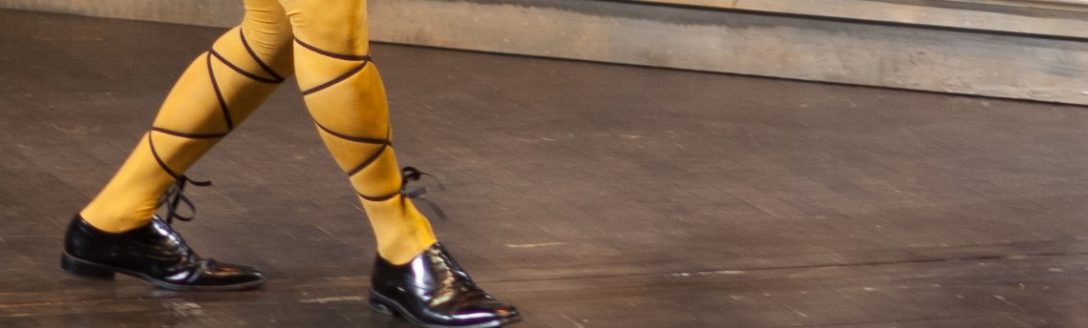
Another thing about that parade – it was likely to be the closest I’ll ever come to being a Disney Princess. In that I was recognized by multiple paradegoers as the character I was portraying, something I didn’t really expect. We weren’t waving from a float or anything; only carrying banners in pairs (“So long lives this, and this gives life to thee.”). But the costume I was wearing had been built for me for a production of Twelfth Night, so I figured I’d wear my yellow stockings and garters with it. We’d be performing at the Birthplace later that day, so I had them along – it wasn’t like I had to run to the Tesco or wherever and grab a pair of extra large men’s tights, bright yellow. Seemed properly festive. I wore Malvolio’s chain of office, too, but that’s more of a footnote detail.

So a little way into the parade, I heard a woman tell what I assume was her granddaughter, “Oh, look, there’s Malvolio. See his yellow stockings?” And yes, we are in Stratford-upon-Avon, where the locals are predisposed to know a touch more about Shakespeare and related lore than your average person on the street and thousands of them are in fact wearing paper Shakespeare masks for a really specific world record attempt (to unsurprisingly creepy effect). Still, I took it as a one-off. By about the fifth person I heard say this, I understood how the college girls playing Belle all summer in Orlando must feel. Except, of course, no autographs; the loving throngs maintained at all times a respectful distance from me, surely out of awe.

Not everyone assumed Malvolio, of course. I was also marching only a few feet behind the couple who has (or, in England, have) been the parade’s Shakespeare for some years. So the true thrill of the odd spectator recognition, if that’s the word I’m after, was “look, dear, it’s Shakespeare and…I guess young Shakespeare.” Very little my hairline and I do is prefaced with “young” so…I’ll take it.

The human mortals want their winter here – MIDSUMMER, II i

It was in the mid-80s Fahrenheit here in Louisville today, and will be again tomorrow. It is All Saint’s Day, the first of November. We broke another heat record, which we’ve done pretty much straight through the summer, which is allegedly over but the year that insists on putting the “ick” in 2016 thinks it can pull a fast one by dragging itself out. Something ain’t right.

There are plenty of people I’ve encountered these last couple of weeks who are just thrilled because they’re, you know, fools. They don’t like sweaters and don’t care about the natural order, which inherently involves sweaters occasionally. Me, I’m with Berowne in Act I, Scene i of Love’s Labours Lost:

          At Christmas I no more desire a Rose,

          Than wish a Snow in Maye’s new fangled showes:

          But like of each thing that in season growes.


I can only assume Mom & Dad are arguing again as they were in the first scene of the second act of A Midsummer Night’s Dream:

          The human mortals want their winter heere,

          No night is now with hymne or caroll blest;


People get all kinds of crazy about this line and what it ought to say, though it seems utterly clear to me and only repeats what Titania says again a few lines later:

          …And through this distemperature, we see

          The seasons alter; hoarèd headed frosts

          Fall in the fresh lap of the crimson Rose,

          And on old Hyem’s chinne and Icie crowne,

          An odorous Chaplet of sweet Sommer buds

          Is as in mockry set. The Spring, the Sommer,

          The childing Autumne, angry Winter change

          Their wonted Liveries, and the mazèd world,

          By their increase, now knowes not which is which;

I’ve kind of always wanted to see a production based around this line – people utterly confused about what the hell season it’s even supposed to be and how we’re supposed to dress. Parkas over Hawaiian shirts. Sudden snow or rain in mid-scene (“Unusual weather we’re havin’, ain’t it?”). No one thinks twice about taking these portents seriously in Julius Caesar or Macbeth, but I seldom see them acknowledged in Midsummer. In fairness, I don’t get to travel much.

          And this same progeny of evills,

          Comes from our debate, from our dissention,

          We are their parents and originall.


(It’s certainly a lot easier to blame it on the domestic dispute (A 273.5 on the scanner) of Oberon and Titania than on ourselves, at any rate.)

Remuneration!–LOVE’S LABOURS LOST, IIIi

I probably should have brought this up before, but here’s the deal with me and Shakespeare of late. The reason I’m writing all this nonsense.

He’s putting money in my purse.

It’s happened before, but never to this extent. Since about February of 2014, I have, depending on how you count it, been a part of either twelve (12) or fifteen (15) Shakespeare productions. Which, I am led to understand, is not normal. This immersion has been full-bodied and has left my brain simultaneously exhilarated and numbed, or if not simultaneously then toggling rapidly from one to the other. This blog is among other things an attempt to get all this down before I forget it, as the brain space is at a premium these days what with all the verse, etc.

For my own sanity and your clarity, let’s lay them out in briefest possible C.V. here:

Hamlet – An abbreviated (a redundancy when talking of Hamlet, I guess) eight-actor touring version in the spring of 2014 in which I played Polonius, the First Gravedgger, and Osric. I continued as Polonius in the full-cast version that followed as part of Kentucky Shakespeare’s summer mainstage season.

A Midsummer Night’s Dream – I finally got around to playing Bottom in my fourth time doing this play (Demetrius in my 20’s, Theseus/Oberon/Wall and Flute/Thisbe in my 30’s). A delight, even with an excessively large, musty, thirty-five-year-old ass head on. This would be the one about which I’d write my Anthony-Sheresque memoir (Bottom’s Up!, obviously). This also marked the stage debut of Oscar, my splendid toupee (named for Oscar Jaffe of Twentieth Century), on which may the iron door never be closed.

Henry V – Fluellen and the Archbishop of Canterbury. Rounding out my 2014 Summer of Yammerers.

As You Like It – a remount of a six-actor cutting I did in 2009 of this one, with commedia masks, an Old West setting, and the opportunity to play Jaques and Touchstone simultaneously thanks to dowel rod lorgnettes and a lack of shame.

Macbeth – another abbreviated touring version leading up to a mainstage remount. I want to count this one as two, though, seeing as I played Duncan/a Murderer/Doctor/Seyton/Probably someone else on tour and the Porter/Lennox on the mainstage, so I had all of about four lines overlap. Felt like a separate production to me, at any rate.

The Tempest – Stefano, with a large sweat-absorbing prosthetic belly and probably more rouge wine blossoms than strictly necessary. 2015 was the Summer of Entering From the House, what with Stefano’s shanties, the Porter’s crowd-climbing/-accosting and…

The Taming of the Shrew – …Petruchio’s big wedding entrance. I had the honor of playing opposite my wife for this one. Saving that for a post of its own. Or the book. (Oscar was in this one, too.)

(I should note here that for the previous three productions I was also company dramaturg/text coach because I suggested that one would be helpful and that it should be me. I seem to have inadvertently pulled some sort of Jedi Mind Trick on the Artistic Director, because it happened. This continued to be true for the following Kentucky Shakespeare shows.)

Twelfth Night – Malvolio, this time opposite my wife’s Olivia. Another pleasure, and, like Bottom, one I had been waiting to sink my teeth into for a long time. I have a much better Yellowstocking Tale from a trip to Stratford-upon-Avon, but again, another post. This was on Twelfth Night itself (and the evenings surrounding), blessedly indoors instead of on the magnificent-in-summer-but-uncomfortable-in-January stage in Louisville’s own Olmstead-designed Central Park.

Two Gentlemen of Verona – Another pairing with my wife, who was Speed to my Launce. Maybe pairing is the wrong word because of the lovely Hope (Crab), who stole most of our laughter, applause, attention, and pride, which is the way of this show and I suspect has always been. I also got to write the setting of “Who is Silvia” for this production. (I played Proteus in college in the 90’s, in the days when all my hair stayed attached to me after the show.)

The Winter’s Tale – Polixenes. What a weird role. What a weird play. I love it dearly. But I defy anyone to deny its weirdness. Unlike anything else. Also a thoroughly justified appearance by Oscar in Act I. And another setting, this time for Sonnet 97 (“How like a winter hath my absence been”) as sung by Mamillius.

Romeo and Juliet – Friar Lawrence. July 2016 being the hottest month in recorded history (until August), it was nice to balance out Launce’s 1919-ish three-piece suit with the updrafty Medieval caftan of Polixenes and the monkish robes of the Friar. Such a pure functionary, which is a great thing to get to play. You’re not going to steal any scenes (or you shouldn’t) because the audience really only deeply cares about two people. So join them, I say. (I was also the dramaturg/text coach for the spring tour of this one, as well as being responsible for the cutting, which was a bit of work and makes me want to count this one twice as a bonus, maybe.)

Titus Andronicus – a Kentucky Shakespeare fall rarity. Previously mentioned in gory detail here. Purely behind the scenes on that one. It opens Thursday.

Macbeth Again – So much Macbeth, this time at Actors Theatre of Louisville until near the end of this month, with a small role that provides plenty of knitting time and time to cobble together this Shakespeare workshop I’m teaching soon.

Purely onstage, that makes twelve (12) productions and in the neighborhood of twenty-two (22) speaking roles large and small over the space of two years, eight months. Somewhere in that time I’ve also finished two separate cuttings of Julius Caesar for next spring/summer, a cutting of Antony and Cleopatra that I think conceptually brilliant but have yet to convince anyone else of (or try terribly hard yet, honestly) and a fair heap of preliminary leg work on another yet-to-be-announced play for 2017. And the trip to Stratford!

I’ve done other things in there (three or four plays from the last hundred years and an understudying gig, probably ninety or so audiobooks recorded, a reasonably major intestinal surgery), but none so connected to each other that they made me want to dedicate an entire blog to them just to clarify my thoughts and tangentially drag other people along for the ride.

So when I seem loserishly footstuck in the Jacobean mires of the rules of performing verse and so on, please remember it’s all I’m allowed to think about. If I didn’t keep a blog, I’d just turn my brain off and play Assassin’s Creed some more and what would that accomplish? (Although a Macbeth or Henriad edition would kick ass. Think on it, Ubisoft. “There’s not a one of them but in his house I keep a servant fee’d – this one’s name is MacGregor. He’s an Assassin.”)

And when I mention one or another of these productions (and I think I’ve at least mentioned every Shakespeare I’ve ever done – wait, no: another Twelfth Night, an Othello, a Richard III, and a college Much Ado About Nothing) eventually in this furious jumble of bloggery, I’ll be able to find them here.

Thanks for the indulgence.
And take upon’s the mystery of things/ As if we were dog spies–KING LEAR V iii (via Hanna-Barbera)

That last post about the sleepwalking scene reminds me of a brief story…

So we broke my nieces a while back. My sister’s girls are eleven and seven (before you ask, Stranger Things and Trek fans, not Eleven and Seven) and have for the last three summers been coming out to see us at Kentucky Shakespeare in the glorious, sticky, open air of Louisville. They’ve seen roughly a dozen from the canon already. (The eldest has a poster with all the Arden edition covers on it in her closet, on which she ticks them off as she sees them.)

They have normal childhood loves, too. LEGO. Horses. Supergirl. Scooby Doo.

My sister occasionally indulges in what I believe is a common parenting activity she calls “pretend bonding”, which involves getting the dishes done or what have you while pretending to care deeply when the youngest recounts the plot of her most recent Scooby viewing. On one particular episode last fall, Danger-Prone Daphne seems to have gotten herself hypnotized (I seem to remember an evil ghost clown being involved in that one; unfortunately timely) and was walking about in a daze – or, as the young’un, six at the time, put it, “her eyes were open, but their sense was shut.”

To which my sister justifiably replied, “What?”

“You know, like she was sleepwalking.”

“Uh-huh.”

We broke the nieces.