…travellers must be content – AS YOU LIKE IT, II iv

I quite enjoyed Andrew Dickson’s Worlds Elsewhere, at least as much a travel book as a Shakespeare book, in which he looks at the ways Shakespeare has been interpreted, adapted, and adopted by non-British places on several continents – Germany, America, India, South Africa and China.

I don’t want to get into a synopsis here, especially for a book that is, by its nature, all over the place, since half the fun is discovery, but it’s a fun ride. The more distant the culture is from his own, the more fascinating things he finds – Shakespeare so within the fabric of Bollywood that hardly anyone notices it, a history of the Deutsche Shakespeare Gesellschaft (the first organized Shakespeare literary society) and its WWII-era intrigues (the Germans like to translate Twelfth Night by its subtitle, Was Ihr Wollt, which is admittedly less controversial than straight-up calling it Triumph of the What You Will, but I suppose Shakespeare Himself had worn out the world’s tolerance for “will”-based wordplay long before Weimar, so I’ll quite while I’m ahead), a primary-source debunking of the mythology surrounding Mandela’s Robben Island Bible copy of the complete works, and the latter-day awakening of China’s fascination with the Bard (A nice primer for 1616: Shakespeare and Tang Xianzu’s China, which is high on my stack right now).

Or maybe it’s the more distant the culture is from my own. I would have enjoyed the book even more if either he hadn’t dedicated about twenty percent of it to America or I didn’t live in America. Not that an outsider’s view of one’s own culture isn’t always welcome and intriguing; more that the modern differences are hair-splitting and the historical differences are something I’m already reasonably well versed in. Your mileage, as they say, may vary. That said, any chapter in which I get to pull out the phrase “a profusion of esculents” (found here in a newspaper account of an unruly Nevada City, California audience and the sorts of edible projectiles they toted circa 1856) is not a waste of my time.

The segment most intriguing to me was his brief glimpse into the life of South Africa’s Solomon Tshekisho Plaatje, whose works I immediately started seeking out to add to the (growing; ever growing) stack. Besides being a linguist, politician (performer, journalist, traveller, intellectual…), Plaatje translated several works of Shakespeare into his native Tswana; I’m probably going to try out his novel, Mhudi, or Native Life in South Africa first – my Tswana is a little rusty…

Another thing that stuck with me was his recounting of an anecdote from American anthropologist Laura Bohannon, who spent time with the Tiv people of West Africa in the early 1950’s. Frustrated by a rainy season in which indoor song, storytelling, and beer (not necessarily in that order) got in the way of her cultural study (I will not editorialize; I will not editorialize), she joined in by telling them the story of Hamlet, which just meant fifteen different things to them, culturally speaking, that it did not mean at all to her. But they seemed to enjoy it:

Some time…you must tell us some more stories of your country…We, who are elders, will instruct you in their true meaning, so that when you return to your own land your elders will see that you have not been sitting in the bush, but among those who know things and who have taught you wisdom.

Even for those of us simply trying to translate these plays for an audience whose cultural distance from Shakespeare is very nearly that of the Tiv, worth tattooing on the arm.

Worlds Elsewhere is  a pleasurable read even for the non-geek. And if you’re not already checking it out, Dickson’s blog (WorldsElsewhere.com) is well worth your time as well.

Mountainish inhumanity – SIR THOMAS MORE, II iv

This has been floating around in Shakespeare- type circles quite a lot lately, particularly this past year and even more in the past couple of days for painfully obvious reasons which my constitution can’t abide. Nor can the country’s.

Very little needs be said about it, but in briefest contextual terms: it is believed that one of the only professional examples of Shakespeare’s own handwriting is a bit of the unfinished group-authored probably unperformed (in its era) play The Book of Sir Thomas More. His work is part of a scene set during the May Day Riots of 1517, during which immigrants from northern Italy were being threatened by Londoners for the usual pig-ignorant reasons.

At the time of the plays writing, the same thing was happening to French Huguenots in London (some of whom were friends of Shakespeare’s, including Christopher Mountjoy, wigmaker and landlord. I don’t know if he made wigs for Will, but he did rent to him), as it continues to happen constantly and everywhere.

Anyway, More is addressing an unruly mob.


MORE.     Alas, poor things, what is it you have got,

                   Although we grant you get the thing you seek?

GEORGE. Marry, the removing of the strangers, which cannot choose but much advantage the poor handicrafts of the city.

MORE.      Grant them removed, and grant that this your noise

                     Hath chid down all the majesty of England;

                     Imagine that you see the wretched strangers,

                     Their babies at their backs and their poor luggage,

                     Plodding tooth ports and costs for transportation,

                     And that you sit as kings in your desires,

                     Authority quite silent by your brawl,

                     And you in ruff of your opinions clothed;

                     What had you got? I’ll tell you. You had taught

                     How insolence and strong hand should prevail,

                     How order should be quelled; and by this pattern

                     Not one of you should live an aged man,

                     For other ruffians, as their fancies wrought,

                     With self same hand, self reasons, and self right,

                     Would shark on you, and men like ravenous fishes

                     Would feed on one another….

                     …Say now the king

                     (As he is clement, if th’ offender mourn)

                     Should so much come to short of your great trespass

                     As but to banish you, whether would you go?

                     What country, by the nature of your error,

                     Should give you harbor? Go you to France or Flanders,

                     To any German province, to Spain or Portugal,

                     Nay, any where that not adheres to England,—

                     Why, you must needs be strangers. Would you be pleased

                     To find a nation of such barbarous temper,

                     That, breaking out in hideous violence,

                      Would not afford you an abode on earth,

                     Whet their detested knives against your throats,

                     Spurn you like dogs, and like as if that God

                     Owed not nor made not you, nor that the claimants

                     Were not all appropriate to your comforts,

                     But chartered unto them, what would you think

                     To be thus used? This is the strangers’ case;

                     And this your mountanish inhumanity.


But as will anything written to be in a play, it’s going to have more literal and figurative resonance if a pro takes it on. I give you two, Sir Ian McKellen (speech at 2:20) and Dame Harriet Walter. See you at the airport.

Where Will doth mutiny with Wit’s regard – RICHARD II, II i

Still hard at work on trimming and annotating Richard II today, and for some reason (which though well known to me, I yet will gag), rang louder today than when last I read it.

At the top of Act Two, a dying John of Gaunt is talking to his brother Ed (let’s call him York) about hopes that the uncounselable Richard will at least listen to a dying man’s advice. Or, In Gaunt’s words:

           Though Richard my lives counsell would not heare,

          My death’s sad tale, may yet undeafe his eare.

To which his brother responds (ellipses, emphases, and a bit of clarifying punctuation are mine):

         No, it is stopt with other flatt’ring sounds

          As praises, of whose taste th’unwise are fond

          Where doth the world thrust forth a vanity

          (So it be new, there’s no respect how vile)

          That is not quickly buz’d into his eares?

          That all too late comes Counsell to be heard,

         Where Will doth mutiny with Wit’s regard:

          Direct not him, whose way himselfe will choose,

          Tis breath thou lackst, and that breath wilt thou lose.


One chunk of this that stood out to me could roughly be restated as, “When any novelty is so distracting to him, can well-reasoned & perspective-considering advice ever come fast enough to be heard by ears where stubbornness rebels against sense?”

Just sittin’ here, readin’ Shakespeare, tryin’ to avoid the news. Good day, all.

Pale trembling coward, there I throw my gage–RICHARD II, I i

Surely this has been opined before, but as I sit annotating Richard II in preparation for sending Kentucky Shakespeare’s cutting out to the summer cast, I can’t help but note that there are two important scenes, the first one and the top of Act IV, in which the throwing down of gages, that is to say, gauntlets, that is to say, gloves figures very prominently. Of the handful of legitimate (non-alternative) facts known about Shakespeare, one is that his father, John, was a glover by trade. It is also known that for the last fifteen or twenty years of his life (he died in 1601) he was plagued by debt for some reason (NB: he was an official ale taster for a time, which is the kind of job that probably keeps its claws in you even when you stop doing it). It is further known that during this time Richard II (among others was written).

Now is it likely that John suggested to his son that “a play with a lot of gloves in it would be great for business”? Is it likely that his son, who knew how to turn a shilling to his own advantage, knew where gloves could be had for next to nothing? No Man Can Say.

But Richard II could in fact be the first known example of the our own time’s most revered tradition of patronage: product placement.

This opened my eyes to myriad opportunities.

Every one lets forth his Sprite ™ – Midsummer, V i (you can see LeBron as Puck, right?)

This haste hath Wyngz ™ indeed – All’s Well, II i

See the revolution of The Times ™ – 2 Henry IV, III i (though lately “Construe The Times ™ to their necessities” might be more apt)

A goodly Apple ™ rotten at the heart – Merchant, I iii (clearly a Microsoft placement)

Our Windows ™ are broke down in every street – 1 Henry VI, III i (clearly an Apple placement; anyone’s dime is good here)

Farewell the neighing steed and the shrill Trump ™ – Othello, III iii (election’s just around the corner, in the grand scheme of things…)


Enough.  Until I get someone to monetize moronic Shakespeare blogging, it’s back to work for me.

And all the men and women merely players – AS YOU LIKE IT, II vii

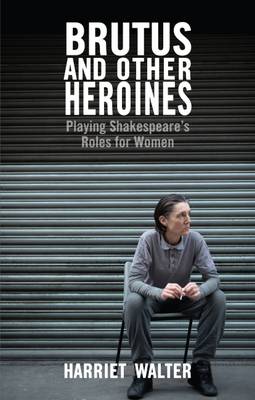
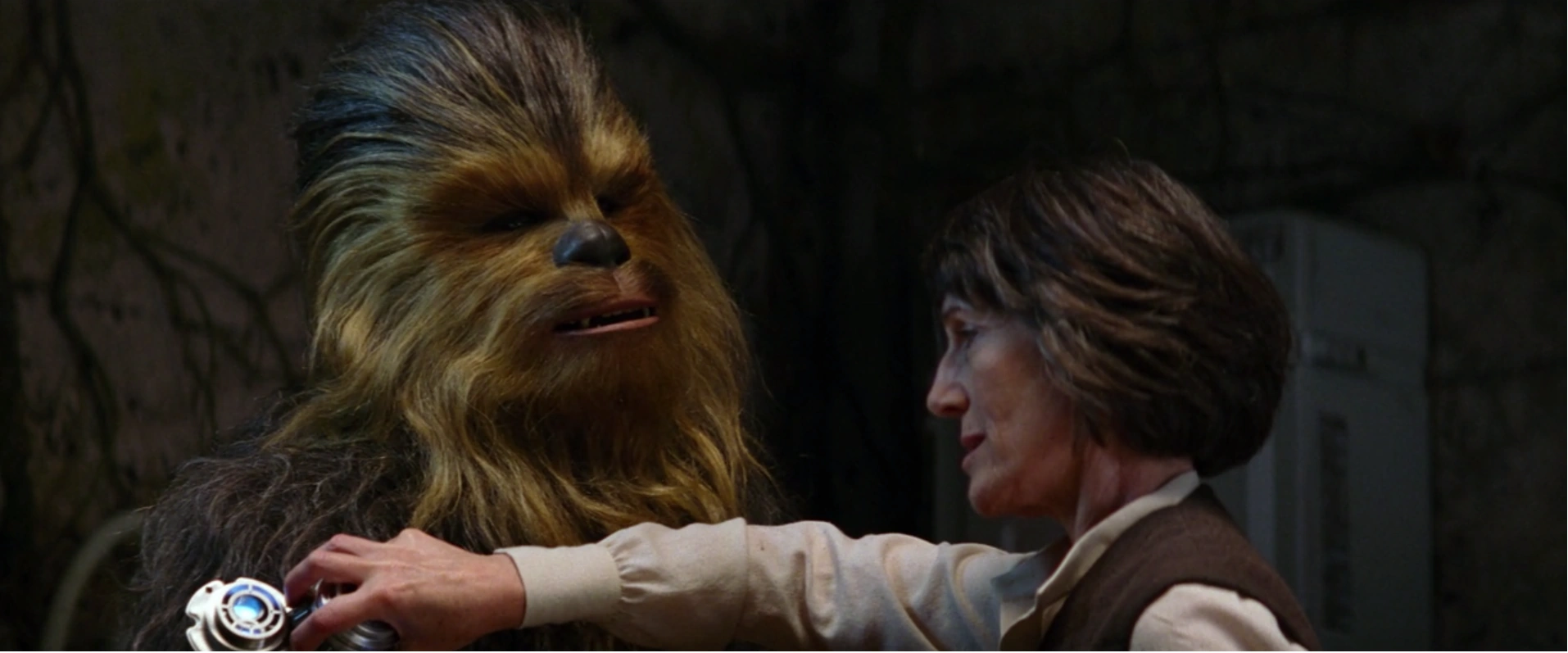
Well worth your time is Harriet Walter’s Brutus and Other Heroines: Playing Shakespeare’s Roles for Women. Walter (who I’m pleased to say is among the ranks of those with their own “fuckyeah” Tumblr tribute) is someone about whom – and this is rare for me – I remember the moment I thought, “Oh, that’s someone doing their work well.” I was a college actor working my first technically professional, technically acting gig at what was technically a theatre performing what the dictionary would define as a role in what we’ll generously call a play. I went to see Sense and Sensibility one night with my landlady (long story) and remember clearly two things (well, three, if you count my general Emma Thompson/Kate Winslet Thing; I am a human): the first was that Elinor Dashwood was the first non-male role as an adult with pretenses toward being an actor that made me think immediately, “oh, I get that person; I’d play that part at the drop of a hat”; the second was that the woman who played her vicious sister-in-law Fanny made this gesture in that scene in the stable, her arm outreached to get Edward to go with her. Right. This. Second. Without saying anything or waggling the fingers at the end of that arm. No big deal in the grand scheme, just a little acting moment, but something I remember thinking of later from a craftsperson’s viewpoint. That she’s only Doctor Tending to Chewbacca in Episode VII to many people is…sad but unsurprising. (Though I’m glad the Lee family was represented again – she’s Christopher’s niece. And the Doctor’s name is Kalonia. I am a human.)

Anyway, while the angle getting this book into conversations is Walter’s recent foray into playing the leads in a trilogy of Shakespeare’s plays set in a women’s prison (and that is covered and covered well in the book’s final chapters as well as an epilogue in the form of a letter to Shakespeare you should most definitely read), even without that up-to-the-minute discussion of stage trend, she just brings such clear and useful perspective to a book that is neither a collection of anecdotes about her creative partners nor a scholarly feminist rethinking of the plays but simply a professional’s recounting of how she deals with character, how that has changed over the span of a career, and how it is still changing forty-some years into that career, which she’s not particularly keen on slowing down.

Full disclosure: I am not a woman, nor was my performing type ever very youthful – I’m in my early forties and have the luxury of only just beginning to age into the roles I’m right for, and while I share good old Keats’s fears that I may cease to be, etc., for women on stage, as Walter notes in her “letter”, particularly in Shakespeare and sadly almost as much in the centuries of plays that have emerged from his impressive shadow and found it difficult not to use his as a template, the challenge is almost always the opposite – an age is reached and the parts disappear, doubly so if a significant piece of one’s career has been spent inhabiting the classics. To Will Himself she writes kindly:

I do appreciate that you were a jobbing playwright with a living to earn and that, in your day, women weren’t allowed on the stage, and I also understand that women (pace your Queen) were not allowed at the centre of public life, so why would female characters feature at the centre of the drama that holds the mirror up to that public life?…Nowadays we are challenging all preconceptions about gender, both in terms of personal identification and public roles, so I hope you don’t mind but I have been playing men recently. I am only following your own example. It seems as legitimate for women to play men as it was for boys to play women.

(I should add here that this is a crusade I’m actively a part of, if only as an actor/sometime director who knows all too well the dispiriting ratio of character gender to qualified, available performer and would love to see audiences willing to embrace all sorts of stage magic and transformation given a chance to embrace another kind.)

But as noted before, while this is the book’s hook, you’ll come for the 21st Century Rethinkings and stay for the wise professional’s thoughts on craft. I have no idea whether this sort of thing is of any interest to people outside the profession, but Brutus is primarily a series of famous roles and how one actor took on each. I should admit here that one of the reasons I’m so pleased to read her thoughts on how all this nonsense we get up to on stage and in rehearsal works is her tendency to reaffirm something I already believe but like to hear stated clearly, so I was prone to be happy to read:

As I see it, my preparatory task is to read and read and read the text and not make too many decisions about the character.

(There, actors of Shakespeare. Just do that. If you must get a tattoo, get that wrapped around your bicep a couple of times. I’m sorry, Dame Harriet. I’ve interrupted. Go on.)

I let the rhythm of her words work on me…I must understand her choices, temporarily inhabit the mind that makes them, say her words and perform her actions, and hope thereby to make her ‘live’.

Walter has a keen sense of where the decision points are in a role/relationship/play, but has an equally keen sense of where mileage may vary. That said, she slaps down a few decisions that don’t hold up under textual scrutiny, the sort that seem like shanties built atop the character instead of gold mined from inside. In plays full of irony and deception, she’s wise about when characters need to be taken at their word. On whether Viola is a schemer in Twelfth Night:

Theories can sound attractive, but when you come to play the part they often just don’t stand up from the inside….My answer to all this is that Viola soliloquises, and there is no example in the canon of a character lying to the audience in a soliloquy. Viola’s soliloquies are full of confusion and ‘what the hell is going on?’ If she harboured any…schemes, I think the audience would be let in on them.

Similarly, she reminds a student (and herself) that emotion (in this case, while playing Cleopatra in Act V) is a byproduct, not a goal:

[‘I dream’d there was an Emperor Antony…’] is one of the greatest speeches I have ever had the luxury of speaking, but there lies the rub. One must not luxuriate in it. The student was delivering the speech so engulfed in her own luxurious misery that the words were indecipherable…I too had loved the luxury of the speech, but I also knew that more important than my feelings were the words and the images that I/Cleopatra had to sell to the audience and of course, to Dolabella, who will take the message back to Caesar.

It’s a quick read, but one I sense I’ll go back and pull thoughts from later, and one that will certainly reward your time. I heartily recommend.

I am most dreadfully attended – HAMLET, II ii

The blog has been dormant for the last week or so because it turns out Guildenstern (and honestly the entirety of Rosencrantz & Guildenstern Are Dead) is mentally exhausting. Who knew? To the point, in fact, where I was unable to chat with friends who came afterwards; the tip-of-the-tongue-the-teeth-the-lips, like a ballet dancer’s feet when unchoreographed, were accustomed to such Stoppard-enforced precision by the end of the night they couldn’t really do much articulating on their own. This seems to have continued over into having anything intelligent to say about the play – or anything that the play doesn’t say just fine on its own.

The pleasure came when the audience showed up – not that rehearsals weren’t fun, but the amount of legitimately hold-for-laughs comedy they mined out of it was even more, I think, than we anticipated. Or I may just have been so mired in learning the whole show over a period of months (memorization was a multi-front war, as it increasingly is with age/repertory, of highlighting, listening to myself recorded, writing it all out in unintelligible longhand, doing the dishes, etc., with a page or two of the script at hand to go over and over, pacing, mumbling, and of course actual rehearsals) that I couldn’t even be bothered to concern myself with how much the audience might respond to it.

It was nice to do for a modern audience we could still guarantee had some familiarity with Hamlet, many of them having seen Kentucky Shakespeare’s 2014 production. For instance: I consistently got a fair (cheap?) laugh with a slight pause – relative to the rest of the pauses in this script – after the second word of the line, “Words, words, they’re all we have to go on” which I thought would be at best a way-homer. There were others.

Unfortunately, I can’t seem to escape. Once I was solidly off book, I allowed myself time for some pleasure reading again and picked from my room-sized To Get Around To stack Kazuo Ishiguro’s recent The Buried Giant, a novel about, among other things, a mist of vague amnesia and attendant anxiety creeping across post-Arthurian England. It’s a lovely book but it’s rather cruelly played into one of the trickiest parts of R&G: the difficulty of remembering a ludicrous amount of very delicate, articulate, repetitive, nay, loop-prone lines, many of which are precisely about the characters’ lack of memory. Not a nice thing to do to oneself.

Then I started catching up on the New Yorkers I’ve left sitting about for a couple of months and opened the December 19/26 issue to find this Alan Burdick piece on the psychology of time, which would have been exactly the sort of thing I picked up a New Yorker to read were it not for having spent the last while trying to get the rhythm right on a line like:

          G: Yes, one must think of the future…

          R: It’s the normal thing.

          G: To have one. One is, after all, having it all the time…now…and now…and now…

          R: It could go on for ever. Well, not for ever, I suppose.

Those “nows” and more importantly their accompanying ellipses are a bear if you want them to sound non-contrived and therefore funny. (The effect was aided by the staging, which had Rosencrantz trying to sit down but startling a bit as each was said, so timing the line was a matter of keeping another actor’s left hip in my visual periphery.) So to pick up an article that quotes William James on the passage of the instant – “We tell it off in pulses…We say ‘now! now! now!’ or we count ‘more! more! more!’ as we feel it bud.” – is to relive something one is trying to clear one’s mind of to make room for the next show.

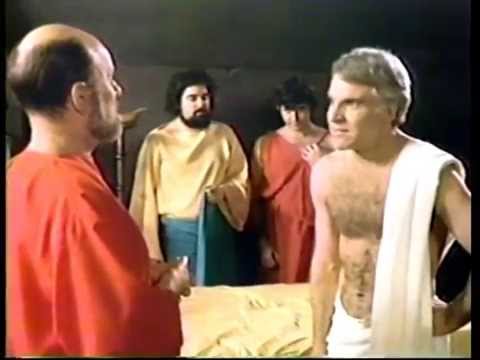
(I could have given James a hand here, honestly. The concept of time exists so punchlines land properly. Any other usage is tangential. Steve Martin once joked in Q&A form (G: “Question and answer. Old ways are the best ways”) that the perfect amount to pause for a punchline was “a second and a half”…which was how long he waited to answer that very question with that very answer. Had James, St. Augustine, and Burdick watched that special sixty or seventy times as a youth as I did – Comedy Is Not Pretty – they’d have had fewer such nagging questions. Though the show had more to say on Socrates than Augustine, I guess.)

This isn’t uncommon, this seeming attack from the outside by the very topic you have no particular intention of being obsessed with or consumed by but which seems to enjoy your company, which seems drawn to you like the disproportionate amounts of dust that surround electronic equipment at home while one is at rehearsal all the damn time. Or not uncommon to me, at least. 

But it does have a way of making one feel like Michael Corleone, as bememed above, is all.

O dainty duck, O dear! – MIDSUMMER, V i

Let me introduce you to my Patronus…

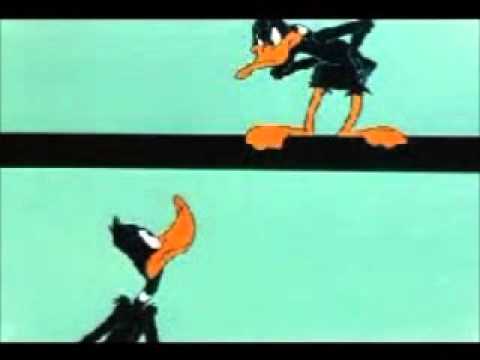
No doubt you are familiar with the Warner Brothers Merrie Melodies animated classic “Duck Amuck” (1953), written by Michael Maltese, voiced by Mel Blanc, scored by Carl Stalling, layed out by Maurice Noble (in some of his finest work this side of the 24 1/2 century) and directed by one of my primary (also prime and primal) artistic influences, Chuck Jones. (This post was very nearly titled “…dearest Chuck…” (Macbeth, III ii) instead, but Bottom won the toss.)

If you haven’t ever seen it, a) I envy the opportunity you’re about to get (though never miss a chance to see it on the big screen) and b) here it is, not in the best visual quality but still magical.

I’ll wait.

Now, as I’ve mentioned one hundred times in self-aggrandizing plug after plug, I’m playing Guildenstern next week in this stellar production of Stoppard’s classic. And what I’m going to suggest to you now, before I get buried in tech for several days and have to lay off the blog while I mumble my four thousand lines to myself for a couple of hours a day, is that the two aforementioned works are as spiritually analogous to each other as the latter is textually with Hamlet.

If you aren’t familiar with Rosencrantz & Guildenstern Are Dead, a) I envy the opportunity you’re about to get to see it on stage (if you’re within driving distance to Louisville, directions are at the link above – January 3-8, curtain times vary) and b) you could always read it, too.

I’ll wait.

I should note here that I’ve always been of the opinion that comedy, especially of the goofier sort, is always a few steps ahead of the avant garde. Beckett is a wonder and a favorite, but Spike Milligan, Peter Sellers, & Harry Secombe were pop stars doing the same thing on radio first, not to mention Laurel & Hardy. The following falls into that line of thought.

Now:

Rosencrantz & Guildenstern = Daffy split;

The Player = The Pencil/Brush;

Shakespeare = Bugs;

Chuck Jones, et al. = Stoppard.

Demolish.


Now to a few tedious work days of tech, then the relative sport of the playing holidays of performance. And then, as Silence drunkenly sang, “we shall

          doe nothing but eate,

          and make good cheere,

          and praise heaven for the merrie yeere” – Happy 2017, y’all!

Say, has our General met the enemy?–CORIOLANUS, I iv

Say, has our General met the enemy? - Coriolanus, I iv

It’s difficult to tell, the internet being what it is, whether we’ve really lost a disproportionate number of beloved cultural figures this year (though it sure seems true) or whether generationally some of them were statistically due (and were of a generation not particularly lauded for taking care of its physical health). And I am not a person who sits around contemplating mortality all the damned time – surviving surgery does put the thought in your head, but mostly it’s made me more determined to Do The Thing rather than spend my energy worrying about the undiscovered country.

That said, The Thing I’m currently Doing is Rosencrantz & Guildenstern Are You-Know-What, so even the simple act of running lines on what was apparently the darkest night in five hundred years this past Solstice means running into:

Let us keep things in proportion. Assume if you like that they’re going to kill him. Well, he is a man, he is mortal, death comes to us all, etc., and consequently he would have died anyway sooner or later. Or to look at it from the social point of view, he is but one man among many, the loss would be well within reason and convenience. And, then again, what is so terrible about death? As Socrates so philosophically put it, since we don’t know what death is, it is illogical to fear it. It might be…very nice. Certainly it is a relief from the burden of life and for the godly a haven and a reward. Or to look at it another way: we are little men, we don’t know the ins and outs of the matter, wheels within wheels, etc. It would be presumptuous of us to interfere with the designs of fate, or even kings.*


…so it’s hard, between work and Twitter, plus the added end of year In Memoriam habit (the best of the genre is always the “TCM Remembers” reel, which I highly recommend, and which I hope they don’t have to update yet again in the next few days; twice is enough), not to have such matter in mind in a year that has seemed kind of cruel even for friends and family, beyond the losses of so many observed-of-all-observers.

And of course I’m torn, as this centering chunk of Stoppard’s Guildenstern could be the admirable kind of stoicism or the other kind – since I’m also working on notations for Julius Caesar, let’s call it the “Brutus showing off how chill and balanced he is in front of his men when he’s already known Portia swallow’d fire for some time” kind. Or whistling, as Blue Valentine-era Tom Waits (and others) would have it, past the graveyard.

There is also the inveterate whinging kind of response – as soon as the Caesar notes are done, I move on to Richard II  and rather than quote a lengthy passage, let’s say starting about here and moving on until he’s actually dead, our title character has little else on his mind or lips. Ros & Guil have plenty of this as well. They cover most options, really.

(I am aware that I’m leaving out Hamlet’s famous contemplations, but honestly, he contemplates just everything, and were there another act nestled between One and Two, he’d have contemplated the recipes of those funeral baked meats and whether they were better hot or leftover. It’s hard to call death his only preoccupation – being preoccupied is his real preoccupation.)

Now, my tendency is to mock…many things, mortality included – the Barely-Inner Groucho is my strongest force (oh, that word). Carrie Fisher’s death was made public a few hours ago, and one of my favorite things about her has always been this (in her case, notorious) B-IG.  It was the real source of her power, not the buns and the blasters and the (still disappointingly clinical) midichlorians.

When I played Feste a few years ago, I got to both sing/play and write a setting for the songs, including this one:

          Come away, come away death,

          And in sad cypresse let me be laide.

          Fye away, fie away breath,

          I am slaine by a faire cruell maide:

          My shrowd of white, stuck all with Yew, O prepare it.

          My part of death no one so true did share it.

          Not a flower, not a flower sweete

          On my blacke coffin, let there be strewne:

          Not a friend, not a friend greet

          My poore corpse, where my bones shall be throwne:

          A thousand thousand sighes to save, lay me ô where

          Sad true lover never find my grave, to weepe there.

…and the choice, what with Feste’s prime goal being survival via remuneration most of the time, when a self-involved ninny like Orsino makes a song request, is going to be the most maudlin (or if you’re reading this in England, Magdalene) thing imaginable. So I composed an ersatz Irish ballad fraught with Melodrame, limping along in 3/4 time, smacking “corpse” and “bones” and “grave” for maximum financial potential. It worked, in the scene at least.

My hope is that if nothing else makes it out of 2016 intact, the mockery will. I have yet to run across any Grand Force (there’s that word again) that cannot be deflated through the pokey pinpricks of laughter at its expense. We’re already seeing how this plays out with would-be human powers in other current affairs, but it certainly works against abstracts when apostrophizing. Or it hasn’t killed me yet, at least.

Fear no more the heat o’ the sun, Nor the furious winter’s rages…     


*Pardon any inaccurate punctuation – I’m working on these lines and I am NOT going to go find the script to check. If I don’t know that speech now, I certainly don’t want to know that I don’t.

Here follows prose. – TWELFTH NIGHT, II v

As I’ve noted elsewhere, dramaturgical concerns arrive like the Spanish Inquisition. Today my wife and I were watching The Year Without a Santa Claus, starring Oscar & Tony winner Shirley Booth (in her final role), Emmy winner/Oscar nominee Mickey Rooney, and the perennially underrated Dick Shawn, among others. You know the one. With the Miser brothers and all.

It’s terrible in its 1974 stop-motion way and its wonderful in its comfort food holiday constancy. And possibly prescient in its climate change metaphors, but I really do not want to think about that right now.

Before I get too far into holiday TV nostalgia, I should note that there’s a legitimate Shakespeare matter here. If oversimplification is permitted here (it is), most of his plays were written in some combination of verse and prose, of speech that’s in a strict (well…on paper) rhythm and speech that ain’t.

There are varying feelings about what, for an actor, the purpose of this difference is. (Not just for the actor, but we are the ones who have to make the difference heard.) Some say it separates the high-born from the low, some the ceremonial/formal from the humdrum everyday, some the sane and/or sharp from the mad and/or stupid. Also letters, as noted in the title of this post – that’s my fellow (fellow!) Malvolio reading from the ersatz Olivia letter.

And all of these are true some of the time, though all of those are demonstrably false some of the time as well. Iago is neither crazy nor a fool, Olivia is plenty genteel of birth. There’s something to each of these takes on when Shakespeare might choose prose, but none is consistently true in a helpful way.

My favorite interpretation is the one I found in Giles Block’s work. I cannot recommend his Speaking the Speech highly enough; I’ve plowed through a huge stack of published works that lay out as many and as varied methods of explaining How To Talk The Shakespeare because I feel like my job as text coach is not to espouse a theory or method so much as find the theory or method that speaks most effectively to each actor I’m asked to assist. His book from a couple of years back is the one I’ve found speaks most usefully and with no nonsense to the widest swath of people.

Block’s take (returning to oversimplification – he has chapters on this and I’m not just going to paraphrase them in toto) is more or less that verse is the sound of sincerity – closest to the heartbeat – and prose the sound of… not insincerity (or not exclusively), but of what happens when a character is out of touch with the heartbeat. So the profoundly stupid, the mentally unstable, people lying to others, people lying to themselves, people carefully crafting their words instead of letting them spill out (as verse almost always does) including those actively trying to entertain an audience in any sense of that word, people dealing with things that are a bit removed from their inmost hearts. Also letters.

Where was I? Ah.

The Year Without a Santa Claus was based on a children’s book by Phyllis McGinley, some of which text is used in the narration. This is going somewhere, I swear it.

(Which means I’ll refrain here from seasonally going on about how it’s bothered me since I was far too young to be bothered by such things, from a poetic viewpoint, that the “arsenic sauce” line and the “mangled up in tangled up knots” lines in “You’re a Mean One, Mr. Grinch” from a different holiday special entirely were obviously transposed in post at some point – you can tell because they’d rhyme with their preceding lines if they were only swapped – listen for it – but the “knots” line is longer, so there was probably something in the animation sequence that made it necessary and while I’d seldom question the wisdom of personal artistic hero Chuck Jones, seldom is not never.)

At one point early in Year Without a Santa Claus the book-based rhythmic/rhymed narration stops and we move, as I noted aloud to my wife as it happened this afternoon, into prose. We then discussed why the impending entrance of the surly Elf Doctor would trigger such a change. Class? Clearly the Clauses are the royalty in any North Pole scenario. Sudden dealings with the quotidian matter of having a flu checkup? I don’t know – a similar scene between Helena and the King in All’s Well shoots a hole in that, though he doesn’t have the flu. Beatrice has a prose cold for part of Much Ado, but she never sees a doctor about it, or not that we hear about. I’m sure Theobald and Pope have reams of opinions on that. The Elf Doctor certainly fits into what Block would call the “prose entertainer” category, or could, if he were more entertaining and less like a stop-motion Charles Lane who’s been put in the dryer and shrunk.

And the letters in YWASC for the most part rhyme! What the hell, Rankin/Bass? Blue Christmas isn’t prose at all.

So what is the main connecting issue?

We finally decided the main issue is that the two of us are idiots.

Happy Holidays, y’all.