I yield upon great persuasion – MUCH ADO ABOUT NOTHING, V iv

All due Nerd Alerts and apologies, if such are necessary by now.

This production of Much Ado About Nothing that’s happening at Kentucky Shakespeare is set (roughly) during the Regency period, with allowances for the fact that a) Messina is in Italy and b) we’re in the business of popular theater, not rigorous Historical Recreation. The most important reasons for this setting are the obvious parallels to be drawn, noticed by even mildly attentive folks long before this production, between this particular play and multiple works of Jane Austen.

The obvious hook here is Pride and Prejudice, what with the saucy woman of intelligence, impatient with her lot in a Man’s World*, and her public war of words with a haughty man who shows no interest in her despite the obviousness (to us) that they will end up together forever OTP shippity ship ship insert tumblr meme here.
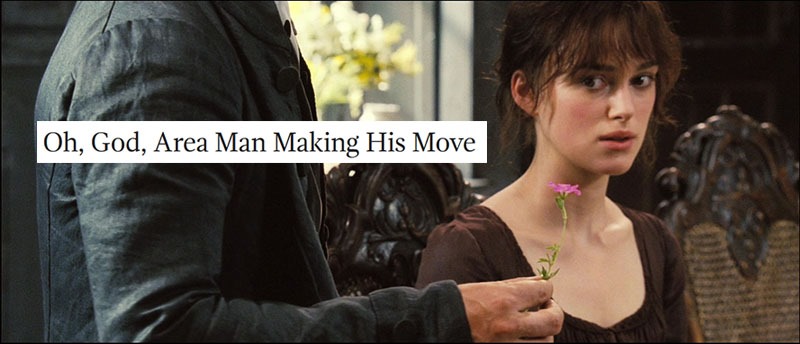
tumblr_nqs1z0L0hd1r8gvzro6_1280

I’m going to presume your familiarity with P&P as it’s a difficult piece of popular culture to avoid, with or without the zombies. And it’s equally difficult while in the midst of a production of Much Ado not to find similarities ranging from the obvious (the romantic naïvete of Claudio Bingley & Jane Hero, Benedick’s list of necessary female qualities that is so close to Darcy’s it’s only a “pair of fine eyes” short of a direct quote, a nice mid-contra-dance spat) to the more esoteric – for example, I’m pretty sure the true Darcy personality analog is Don John and not Benedick; Benedick is a Wickham if ever there was one, in public at least, the private behavior of Wickham being the purview of Borachio instead. Austen just swapped their places in the structure of the story – true to form, it’s the men Austen finds interchangeable (Don John as he is would probably be at least as at home in Northanger Abbey as he is in Shakespeare) and makes almost tangential, just problems to be dealt with by the women, to whom she gives a society and inner life of their own. Take Leonato’s wife, Innogen (if you can find  her), a character that appears in a stage direction and a half and is given a name (barely) but no lines. Our knowledge of her existence seems purely due to an early draft in which no one got around to scratching her name out. I like to think of Mrs. Bennet as Jane’s Revenge for this oversight, a double verbosity to balance a muteness.
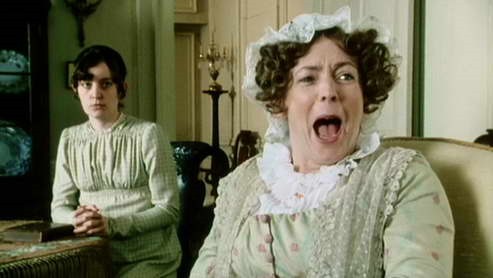
P&P 1995 mrs bennet

Abigail and I, in working on Bea & Ben’s scenes also noticed strong ties between the whole Kill Claudio business (if you’re reading this before you’ve watched our second half, spoiler alert) and the Vacationing Lizzie Tells Darcy About Lydia & Thinks He’s Skipping Town Because of It Which He Is But Not the Way She Thinks scene.** There are differences between the situations of the two women’s shamed relatives and between the types of dutiful feeling that spur the two men into action (Benedick loves Claudio and Darcy loathes Wickham, for starters), but the similarities are so clear that it feels wasteful to go into more detail.

Also notable to us were the equally quotable direct-yet-confusing declarations of love – what is “You must allow me to tell you how ardently I admire and love you”, followed by details of Darcy’s sense of the general Bennet inferiority if not a one-page restating of Benedick’s single sentence “I do love nothing in the world so well as you; is not that strange?” And towards the end, note Lizzie’s “Now be sincere; did you admire me for my impertinence?” when laid alongside Beatrice’s “For which of my good parts did you first suffer love for me?” This isn’t brain surgery, but neither is it coincidence.
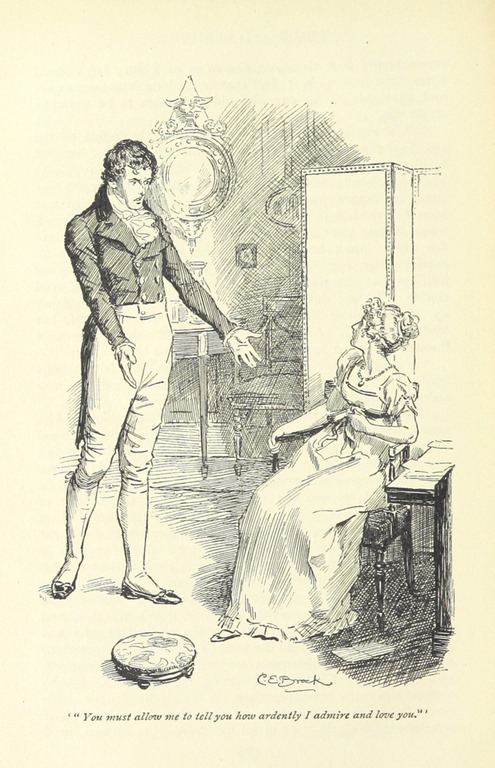
pride-and-prejudice-3

But to me, while the comedy angle of the Beatrice and Benedick plot (minus the elements of farce Jane disposes of) takes place very nicely alongside P&P, an important part of Much Ado also bears a strong resemblance to Persuasion, in that our pair of inevitables have some sort of history together that took a bad turn before the story begins and will need to be righted before it can end. Also, the word “prejudice” appears nowhere in the play – though in her snappy little soliloquy after she’s tricked into belief in Benedick’s lovesickness, Beatrice does come forth with “Stand I condemn’d for pride and scorn so much?/ Contempt, farewell, and maiden pride, adieu” which is really pretty close, sensewise – but there’s “persuasion” right in Beatrice’s final line (as noted in the title of this post). I’ve left out Mansfield Park, but it gives off more of a King-Lear-meets-All’s-Well vibe. Hamlet is read aloud in Sense & Sensibility, which must count for something.

On the subject of Emma, however, Shakespeare remains silent. Unless she’s Puck… Maybe some other season.

laurence-olivier-and-greer-garson-in-pride-and-prejudice-1940-large-picture


* It could be argued that this wasn’t really Austen’s focus, but it’s certainly an aspect that registers significantly now.

** I turned to my lovely wife for many of the Austenian particulars in this post; I enjoy those six novels greatly (and I also recommend Love & Friendship, Whit Stillman’s adapted Lady Susan – the film is delightful and his modification of the book is doubly so) and am an avid and unashamed watcher of any nine-hour BBC whispers-and-corsetry melodrama, but Abigail is fleeter than Google when you need a quote or a scene location from P&P. Ponder for a moment how many novels you can readily quote from if you’re a normal person whose job doesn’t require it. Not that she’s a normal person…

…an improbable fiction – TWELFTH NIGHT, III iv

All three shows in this summer’s season of Kentucky Shakespeare feature one of those little moments I love, which keep us (the show-makers) from getting too precious about ourselves. Shakespeare loves to throw these in, but they’re not always there and I’m glad we have one in each of this year’s scripts.

That is to say: cheap and easy metatheatre, not of the more obvious and showier Hamlet/Midsummer lay-within-a-play type but rather that kind where a character says in so many words, “Huh; it’s almost like you people are watching a play right now or something…” and the audience says, “Yup.” No litcrit treatises required, just a pleasant but trippy little flash of the Droste effect.

The techniques of actors are mentioned when the conspirators meet in Julius Caesar and Brutus admonishes them not to look all dark and guilty about this (“good! – I swear! – good!”) project they’re about to embark on, lest someone catch on too soon:

          Let not our lookes put on our purposes,

          But beare it as our Roman Actors do,

          With untyr’d Spirits and formal Constancie,

“untyr’d” in this case playing with the obvious sense of “not tired” but also “undressed”, “not attired” (seeing as how the Frenchy word “costume” didn’t sneak across the Channel for another couple of hundred years and actors were still changing backstage in what they called a “tiring house”), which is gloriously tricky talk: don’t look guilty because a) that will blow the whole plan but also importantly b) what, when you strip everything away, do you have to look guilty about when our basic purpose is so gosh-darned pure? Oh, Brutus. Stoicism doesn’t mix well with your naïve grasp on human nature. Been there, pal.

But that’s less metatheatre than a useful simile. The fun bit comes right after the fun and difficult to stage stabby scene* when Cassius has the (purely genuine or meant to manipulate or both? Actor’s call) philosophical presence of mind to wonder:

                                       How many Ages hence

          Shall this our lofty Scene be acted over,

          In State unborne, and Accents yet unknowne?

Brutus picks up the thought:

          How many times shall Caesar bleed in Sport

          That now…lye along,

          No worthier than the dust?

And then Cassius chimes back in with one of the play’s many understatements of gross miscalculation:

          So oft as that shall be,

          So often shall the knot of us be called,

          The Men that gave their Country liberty.

The path of that thought gives the audience a nice trajectory from “You called it, Cassius” to “Cool; we’re watching that happen right now” to “But guys, that whole spin doesn’t really play out for you in the long run” (or, if the audience knows the play, even the incredibly short run).

Richard II is all about pageantry and a king who lives for it, but he doesn’t speak in theatrical terms as often as you’d think. The real meta moment comes just after his super-fancy deposition scene with the broken mirror and the “Ay, no, no, I” business and all kinds of melodrama, Richard being a terrific part to tear a cat in** – and the next scene starts with Richard’s uncle York telling his wife the story of Henry IV’s triumphant ride amongst the people and the way-less-triumphant Richard’s similar ride after him:

          As in a Theater, the eyes of Men,

          After a well grac’d Actor leaves the Stage,

          Are idlely bent on him that enters next,

          Thinking his prattle to be tedious,

which manages both to compare the less-popular Richard with the triumphant Henry, but also compare the scattered and about-to-be-quite-comic (at last – this play is sparse on the levity) actor playing York with the impressiveness of the big Richard set piece that preceded this little scene of would-be domesticity and boots. I laugh every time in rehearsal, and the actor playing York isn’t particularly playing it up. It’s just unavoidable.

There’s little of this in Much Ado, since the scenes in which Beatrice and Benedick are tricked into romance are so inherently theatrical it’s scarcely worth mentioning in great detail. But just in case you were nodding off, at the end of the fooling of Benedick, Don Pedro mentions it anyway:

          the sport will be, when they hold one an opinion of another’s dotage, and no such matter, that’s the Scene that I would see, which will be merely a dumb show…

“merely a dumb show” being an odd way to describe any scene between Beatrice and Benedick, who even for characters in Shakespeare are chatty (and prose-chatty at that which is harder to memorize than verse-chatty, believe you me). Perhaps he’s just thinking wishfully; perhaps, considering that the dumb show usually served as a prologue to the main action, that’s more what he’s going for. There are, as always, options.

As I said, I’m happy these little nuggets appear in each of the summer’s plays because I love to look for the little similarities in plays that weren’t chosen by that criteria. More connections will start popping up once we’re doing all three in rotation. They always do. Assuming there’s anything left of our minds to notice such things at that point…


*I’ll be Caska in ours and I’m looking forward to going in with the first poke, partially for Drama and partially because it’s only going to get harder to stage from there.

** that’s from Shakespeare…

for ALWAYS I am Caesar – JULIUS CAESAR, I ii

During the week of May 8-14, I:

-was a part of the first read-through of Kentucky Shakespeare’s impending summer togas-and-all Julius Caesar;

-saw Kentucky Shakespeare’s 90-minute outdoor spring touring modern dress production of Julius Caesar;

-saw Shakespeare Behind Bars’s annual production at Luther Luckett Correctional Facility, directed by the same director as the previous two. Did I mention it was Julius Caesar?

It’s fascinating to experience so many related-but-unrelated productions of the same story in such a short span, especially having connections with each. Obviously I’m in one of them. I did the 90-minute cutting for another. And I’ve seen I think seven performances by the men of Shakespeare Behind Bars – the work Matt Wallace does with them as facilitator of these productions (which is like directing but allows them to take over a lot of the heavy lifting, especially in letting the older hands help in making the newer members of the group learn the ropes) never ceases to move and amaze.

And by move, I don’t just mean emotionally – those guys do not waste time or air but hustle the show along at a pace and with a clarity that professionals should pay attention to – they worked from a very lightly trimmed script (I think Antony’s servant, Cicero & Caius Ligarius were the only real cuts) and came in at about two hours and five minutes including intermission. Ponder any production you’ve ever seen and do the math. And they didn’t rush. They just moved. Everyone knew what was being said and didn’t worry about showing off emotionally. There wasn’t time; too much stuff was happening.

The thing that’s especially impressive about these productions is that often performances of the sort of Shakespeare Behind Bars are purely art therapy, which is valuable enough on its own. But in the dozen years I’ve been able see these performances, I’ve seen so much growth among the men as performers as well. I’ve also had the benefit of conversation with many of them about Shakespeare and performance (and pretty much exclusively that) and let me assure you they know what they’re talking about when they talk about those things. I count them as some of the most rewarding conversations and audience experiences of my life.

The performers also have a real knack that I wish I could figure out how to transfer to pro productions, which is this perfect toggle between utter silliness in the parts that should be played for laughs and the heightened tragic or supernatural. Lucius’s borderline narcolepsy that bookends the appearance of Caesar’s ghost, for example – they proved it possible to make an audience spring from goofy to intense and then relieve them back into goofy, thereby landing in a nice median from which we could move into the next matters at hand. That sounds like a weirdly specific thing, but it is a constantly useful skill when dealing with Shakespeare.

The 90-minute tour I have to step back from complimenting because I had a hand in it and therefore it’s not my place, but I really dug the modern setting. Those can go up and down. I’ve probably said here before that I’m less interested in whether the production obeyed the tenets of presumed original historical Elizabethan practices or was devised by puppeteers through theatre games and more interested in whether it was good. This simple black-suits-&-political-posters version with only six actors worked really well. There was little effort to be on the nose about anything politically specific so much as just let it be, which is for the best. If one is determined to shoehorn in precise cultural translations, they had all better work and they had better line up parallel across the full board. This one kept it generally in the political sphere (because that’s where the story happens) without trying to make anyone too precisely represent any one modern situation.

The reading was fun if only because I got to wear my dramaturg hat as well as my bald actor pate.* And I’m Caska, which means a light and frothy second half as a couple of one-liner soldiers. It’s terrific, this relatively calm second act, and will be even better once the reality that is an Ohio Valley July sets in. You can sometimes gauge actors’ ages or experience purely by how they respond to the idea of reinstating or cutting lines. Especially in a rep company when you have a fun and chewy role in one show and a medium-to-small role in the others. All actors are Nick Bottom at heart, but there’s a time when even the theatrical ego takes a relieved back seat to mental and physical exhaustion.

Alright. Onward. The Bishop of Carlisle isn’t going to memorize himself.

* The reason there’s been precious little action on this blog of late comes down to that as well – rehearsals started May 1 and I’ve been here for every scene every day until yesterday. At some point I should probably get fully off book for Benedick (I’m THIS CLOSE**); Greene and the Bishop of Carlisle are less of a worry, since Richard II opens two weeks later and I have only about two pages worth of lines, all verse, to Benedick’s twenty-five of prose.

**Update: got it.

Avaunt, and quit my sight! – MACBETH, III iv

I have one measly day off.

I chose to ignore the citywide bacchanal that is the Kentucky Derby because I’m marshaling my energies. I read, there may have been some knitting, and I spent a fair amount of time planning the first session of this Shakespeare readers’ workshop/book club/thing I’m doing this week. We may have watched the entirety of Princess Leia’s Stolen Death Star Plans with our lunch. There was a cocktail, another thing, like free time, that will be scarce as the summer continues (for vocal protection).

At 8:00, The Bad and the Beautiful, which I haven’t seen in quite a while, came on TCM. It’s good (an Essential, even*), so I left it on. Shields (Kirk Douglas) comes to Georgia‘s (Lana Turner) apartment and finds out she’s daughter of a (dead) John Barrymore-esque actor he had known. He puts on a record of her father performing (voiced by Louis Calhern, which I just realized I should look up and check except I know that voice and have no need to confirm). He is of course performing Shakespeare. Because as I have noted time and time again, I am not allowed to escape.

Calhern is doing a gloriously orotund Macbeth, kicking in at “She should have died hereafter”, but then (because that’s what I’m listening to, of course, not the scene that’s happening on top of it) the audio loops back to an earlier bit from before Lady M.’s death with which I’m reasonably familiar. (My wife confirmed it, as she remembered hearing it while waiting to scream offstage when she played said Lady.)

But I decided not to let it ruin my night; simply to accept the inevitable. And keep watching, at least until Gloria Grahame’s part is finished.

I wouldn’t mention it here were it not the second time it’s happened this week.

Rehearsals started Monday, so we’re not in crazy crunch time like we’ll be in, oh, another week. So we thought we’d tick one off the DVR on, I forget, Tuesday or Wednesday. We watch a lot of Cagney and a lot of the sort of comedies of that era some call screwball, yet somehow neither of us had seen The Bride Came C.O.D.

It’s a so-so movie, mostly a rejuggling of It Happened One Night, but on a night off I ask little, just a dopey bit of escapism after a long day of acting (and dancing) Much Ado, and a few minutes in, on comes the manipulative radio announcer (Stuart Erwin) to report that “the musical world’s most eligible bachelor, Allen Brice, will tonight become a Benedict”.

Now, I ask you. This isn’t even a movie about actors where one might expect that sort of thing. Unfair. Badly done, DVR.

Back to work tomorrow. Heaven knows what will accost me in my three-week-old New Yorker on the bus.


* And full of great lines. “There are no great men, buster. There’s only men.” Also Gloria Grahame, for which I would watch and have watched nearly anything.

O if you raise this house against this house… RICHARD II, IV i

Something that’s been discussed as we begin this multi-season Henriad enterprise at Kentucky Shakespeare, with casting and design that carry over from production to production and year to year until we’re done or it kills us (it’s hot out there), is how to…not change anything about the plays themselves, exactly, but how to convince people that they are certainly no harder (and perhaps much easier) to follow than, say, Game of Thrones.

And yet when you mention Shakespeare’s Histories to even a fairly well-read person, there’s that tendency to recoil, as if the word “history” has already made things sound homeworky and antiseptic. Often the person will be able to bob and weave effortlessly through the subtle complexities of House Lannister or the cultural reasons for dwarf/elf antagonism in Middle Earth, but as soon as the names aren’t made up, they go cold as any stone. Never underestimate the educational incentives that are Boobs’n’Dragons, I guess.

I need to be clear here that I’m casting no aspersions – this is more of a marketing perplexity. I’m an avid watcher of Game of Thrones, a still-avid reader of Tolkien (though there is a point at which I don’t need to read every published napkin he scribbled on, Christopher). I’m working my way through Rothfuss, too, though I’m enjoying it enough that I’m intentionally making it last.

That’s a good example, in fact: the Kingkiller Chronicles have a distinctive world with distinctive rules, but they are being told to you as if you already knew those rules, which you then pick up by context and gradual revelation. And people love it because the writing is good. I don’t think I’m being excessive when I say it would be easy to write the same sentence about the Histories.

I wonder if it would help people to know the plays are wildly inaccurate. Maybe not wildly, but certainly…condensed & made more legendary than factual. Partially because you’re on dangerous ground when you start attaching motives to people whose Houses are still walking the streets and patronizing theater companies and beheading people. Partially because speculation is more interesting, even within those boundaries. Partially because of the bit of wisdom from John Ford (the filmmaker, not the Jacobean playwright – though cf. Angela Carter’s “John Ford’s ‘ ‘Tis Pity She’s A Whore’” which is a favorite of mine) regarding whether to print truth or legend (I’m betting both Fords would agree the latter).

In fairness, there are people you’re introduced to whose names you barely know and whose backstory you have to imagine, if you even care to; even a historian would have some trouble digging up useful information on some of the all-but-supernumeraries. But if you put this in a modern scenario, these would be the very characters making a living by making appearances at conventions populated by people who learn Klingon (and therefore can totally handle Elizabethan English). Signing autographs and obscure Kenner figures, taking photos with fans astounded to meet “one of the guys who drowns George, Duke of Clarence!!”

I’m trying to avoid bringing the Hollow Crown series into this so as to duck the inevitable flaming that would follow my true opinion, but suffice it to say that it is not the answer I’m looking for.

Anyway. I don’t have a conclusion to this ongoing process. I’m just musing as I type or vice versa. Fortunately, this is only Year One. We just have to convince audiences to see Richard II, which in this political climate should be a cinch.

…exceeds her as much in beauty as the first of May doth the last of December – MUCH ADO ABOUT NOTHING, I i

When I think of the phrase “first of May” I think a little of May Day, the international labor holiday, a little of my college roommate’s birthday, but primarily, for reasons that don’t even make sense to me, of the circus.

When you’re a lover of lost slang, it’s hard not to let it creep into your bones, be it Elizabethan, vaudevillian, or carny-speak. And to those who work in carnivals or the circus, a First of May is what we now a little less poetically call a noob, a greenie; Firsts of May (which I only realized while typing must be the proper plural, if things like that matter to carnys, or carnies, though spelling doesn’t seem to matter to them so surely this doesn’t; I just like the way it sounds) are novice workers starting their first season, which at some point in the pre-air-conditioning, agrarian world of the touring circus was around that date.*

The first of May this year also marks the beginning of summer rehearsals for Kentucky Shakespeare. I’ve been editing scripts since, oh, November**, and the other elements of pre-production have been happening for a while, but tomorrow marks the day the cast, crew and directors all gather in one surprisingly chilly room with gaff tape in strange formations all over the floor to sit around a couple of rectangular tables and read a couple of four-hundred-year-old plays aloud in that weird way of all actors at first read, the initial “let’s just read it and not worry about the acting” phase lasting about fifteen or twenty pages until the acting kicks in regardless, along with weird reading errors and self consciousness masked as total unselfconsciousness and inappropriate laughter and awkwardness where the fights and kisses will come later and all that jazz.

And despite the wide expanse of professional experience, for a while we all feel like Firsts of May who don’t really know how the hell any of this works. No one will be cowardly but we’ll all kill the poor script many times before it tastes valiantly of some well-rehearsed death once we’ve choreographed all the stabbings (though that won’t be for a few rehearsals yet – we’re starting with Much Ado and the stabby plays are later in the summer).

I’ve packed the old valise I found for $15 at a thrift store with the Crystals’ Shakespeare’s Words, Logan & Coye’s (oft-conflicting) books on pronouncing said words, the Ardens and Freeman’s Applause Folios of all three plays, the full scripts I annotated, the sides I printed out for myself so I don’t have to carry the whole schmear around when we start staging, two scribbly, battered notebooks, a couple of green pens and pencils, an old pullover (again, surprisingly chilly room), a twenty-year-old mug for summer tea (Daffy Duck in various stages of being un-beaked), and my official dramaturg hat. Oh, and lunch. I have to remember lunch. Don’t let me leave here without lunch.

You have to watch getting too precious and ritualistic with actors because half will immediately parse for superstitions and the other half will inwardly (at least) mock the preciousness and the ritual, but I love that big, lumpy first read, the optimistic smell of all those sharpened pencils, new photocopies, and coffee. We get to do something honorable for a living** as long as we do it honorably. I’d say “with the very bent of honor”, but that would only remind me that instead of waxing obnoxious here I should be working on my lines for the second half of the show. So I won’t.


* This year the sixth of May will be the simultaneous running of the Kentucky Derby and the running of me from the Kentucky Derby. I don’t like crowds, traffic, or price-gouging quite enough to want to do anything but hide in our house here in my lovely-fifty-weeks-of-the-year hometown. I am tempted by another event that day – my last chance ever to see Ringling Bros. circus, six hours away on my last day off for almost three months. The jury is still out.

** The wisest of all theater truisms has long been “NEVER try to figure out what you’re making by the hour; it will only lead to weeping.”

This is my birthday – JULIUS CAESAR, V i

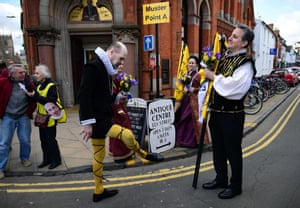
A year ago today I marched in a parade, chilly in the yellow stockings that named this blog,  vitals girded by some sort of lycra and velcro device that allowed my abdominal muscles, almost precisely one month after surgery, some rest for a full day of performing, first at Shakespeare’s New Place (at that point not yet reopened) for the BBC and later at his birthplace, and then walking about and chatting at a shindig here and a fete there. There was a nap scheduled in there somewhere.

It was exhilarating, partially because my health had very recently been such that I didn’t know if I’d be able to make the trip, or do much of anything for some time.

A couple of days before, the whole Kentucky Shakespeare contingent visiting Stratford enjoyed a trip to the vaults, during which time the kind women who mind the delicate antiquities told us to “go ahead and touch” the register of the Church of the Holy Trinity – the animal-skin vellum was going to last another 500 years and our grimy mitts (daintily and tenderly applied, I assure you) weren’t going to do it any particular harm. There was the original registry of Shakespeare’s death, which today seems to be the definite anniversary of.

Earlier (obviously) in the book there was a copy of the registry of his christening, as the whole book had been recopied during Elizabeth’s reign at some time after Shakespeare’s birth.

As is widely known, the whole birthday thing is a guess – it’s very likely that Shakespeare died on his 52nd birthday, which happens to be the saint’s day of George, dragon-slayer and patron of England, but we may have been a day off in one or another direction. But the symmetry is appealing. And easier to remember. And if the ancient honchos of the Catholic Church were willing to just throw Jesus’s birthday at the most convenient and useful spot on the calendar, I suppose the placement of these things aren’t all that important.

I am a fervent resister of any attempts to attach Shakespeare’s work to his biography. If he was Prospero or Hamlet, he was also Iago and Paulina and Lady M. and the guard who tries to speak up for Gloucester in Lear. And we only speculate that the sonnets tell us anything particularly private, or that the wording of his will does so.

But I’m willing to indulge in the fun Time-Life Mysteries of the Unknown fact that in Julius Caesar, Cassius makes note (see title of post) on the eve of battle that it is his birthday and, to paraphrase via Howlin’ Wolf, “I ain’t superstitious but a black cat just crossed my trail”. And the audience doesn’t have to be superstitious to be aware that we’ve just started Act V of a tragedy, so bodies are going to start dropping soon, Cassius’s among them.

Now clearly Shakespeare did not, in a play written seventeen or so years before his death, have foreknowledge that he’d go on his birthday, unless he went out and did something dumb every twenty-third of April to tempt Fate and Fate just didn’t win the hand until 1616. But the symmetry is appealing.

This year I have the good fortune to celebrate Shakespeare Day from the comfort of our home, healthy enough to get out and do some of the yardwork I have so despised since I was about twelve. I’ll work on the lines my aging, lint-filled brain is trying to learn for a show that opens in about five weeks and rehearsals for which start in eight days. I’ll sit down with this novel I’m trying to finish before our summer gets crazy, or with one of the New Yorkers I’m trying to catch up on for the same reason. I might watch some Buster Keaton, who made his film debut on April 23, or listen to some Mingus, another birthday boy.

But nerds though we be in my household, we don’t do much in the way of partying for Shakespeare’s birthday. This date also marks the day my wife lost her father back at the beginning of this century, and while time has gone by, it’s never going to be sunny and springy.

Her father’s name was George and the dragon won that round, and though we haven’t talked about it much in these terms, I don’t know whether it would make it easier or more difficult to spend St. George’s Day contemplating a stack of plays almost all of which are preoccupied with thoughts on the father/daughter relationship or that pain of loss which shadows even the silliest of the comedies.

But the symmetry is appealing.

…And for your love to her lead apes in Hell. – TAMING OF THE SHREW, II i

My wife seems to talk about this on stage a lot, but no one knows what it means.

By “a lot” I mean twice, as she’s played the only two characters who talk about leading apes into Hell in Shakespeare. But that’s 100%, so…

Much like misty origins of the horns of a cuckold, there’s no backstory universally agreed upon with the apes here. Of feminism’s many upsides, the reduction of the stigma of being An Unmarried Woman is but one – yes, there are still pressures and advertisements and tsks from older relatives (who are going to tsk about something anyway) but it’s been a long time since I’ve heard the word “spinster” or “old maid” used without irony and your meddlesome aunt, while perhaps asking you more than you’d like about whether or not there’s some nice boy who’ll keep you from dying alone in your apartment, is at least not going to suggest that your soul is doomed to lead tethered apes into hell for all eternity. Unless she’s a terrifying fundamentalist of some stripe, at most maybe you’ll be saddled with Crazy Cat Lady. Which, sure, is still sexist, but is of much lighter weight than having your soul doomed to lead tethered apes into hell for all eternity.

Many seem to agree that this mythic fate has as much to do with not having had any children as with not having been married. Which, having seen the behavior of young children from a safe distance*, sounds like a balanced exchange. If one goes not forth and multiplies not while on earth, one must agree to do something similar after. Fair enough.

Others insist that the “lead” of “lead apes into hell” is an Elizabethan euphemism for intercourse. Not impossible. And apes have always proverbially sexually uninhibited (everyone insert zoo field trip story here). But. Fun fact: it is possible to find a scholar who will tell you that every last verb/noun (and a few articles) in Shakespeare is an Elizabethan euphemism for intercourse & concomitant body parts. All of them. Which, I mean…he’s incredibly randy, but…this is just one more way the Freudians ruined a lot of adult conversation.

**

There’s a version of the proverb suggesting the “maids about twenty lead apes in hell”, suggesting that it’s less about reaching “old” age unmarried and more about maintaining one’s virginity for too long. And on Shakespeare’s behalf, considering the topic of oodles of sonnets, the whole “go on and reproduce, why doncha?” issue was not gender-specific for him.

The phrase “ape-leader” hung around for a surprisingly long time, but didn’t have the staying power of “spinster” (or the solid playing card marketing of “old maid”). The thing I like about its appearance in Much Ado is the wordplay piled on top of it.

If you know Elizabethan culture, you know that it’s primary feature was being gross. One of the gross things they enjoyed a lot was watching bears fight with dogs in a public arena. I don’t pretend we’re super enlightened, but, come on. And occasionally there were apparently apes thrown into this mix as well, presumably because they had the sort of digits that could handle folding chairs in proper McMahon-approved fashion.

So the Bear-herd (or Bear-ward), the guy in charge of herding (or warding) the bears, also led apes around himself. No word on whether this was a punishment for his likely marital status of Available, what with the inevitable smell. But as we’ve said, the Elizabethans were uniformly gross, so maybe it did him no harm, plus he could make some money on the side whenever a revival of Winter’s Tale came along, I guess. “Bear-herd” is a weird word to say. Try it. A few times. It’s fun. Notice the way the “h” disappears as in “shepherd” and you’ll get why in this scene in the Folio it’s spelled “Berrord”.

Going back a few lines, you’ll hear (if you’re reading aloud as you should) a lot of still fairly clear semi-bawdy chatter about men with/without…Beards. Which in the accent of the day was a similar sounding word – Beard/Berrord – enough to put the other in Beatrice’s mind. And in the full sentence where it appears – “therefore I will even take sixepence in earnest of the Berrord, and leade his Apes into hell” – it springs out of a variation on what was even then the boilerplate financial-contract-ese of “in earnest of the bearer”.

Beatrice’s gleeful improvised version of what will really happen to her once she’s dropped off her requisite apeload makes me very happy. She won’t go all the way into Hell but only

          to the gate, and there will the Devill meete me like an old Cuckold with hornes on his head, and say, “get you to heaven Beatrice, get you to heaven, heere’s no place for you maids”

(the Devil being, of course, puritanical enough to want to protect virgins from such an infernal place – no surprise that Shakespeare casts Satan as a Puritan). In Heaven, St. Peter then shows her

           where the Batchellers sit, and there live wee as merry as the day is long.

In the space of a few lines, she upends a dearly-held sexual double standard without particularly attacking the readily attackable male goons who surround her (they’re hardly worth it at this point, though things get ugly later…Pibling Leonato has more comeuppance coming up than he gets), like a late-sixteenth-century Mrs. Maisel (which you should watch the pilot of on Amazon Prime, because it’s really very good).

She’s a clever Old Maid, Beatrice. I’ve always loved her, and not just because she was attached to Emma Thompson when I first encountered her. There are just character you grok and admire the thought processes of, and she’s high on my list of those.


* The Wife and I are an aunt/uncle, or as recent non-gendered coining would have it, Piblings (unlike most such coinings, this one is actually fun to say, so score one for us there) and love our nieces and nephews (Niblings, which, while equally sonorous, has a playfulness that I fear belongs to a more innocent time), but are not cut out for the full-time job of parenting and are happy to be occasional fresh horses in the villages that it takes to raise each of them – specifically the horses that force “cool” movies/music like cultural lima beans down their metaphorical gullets.

** the almost illegible Valentine doggerel reads:

          You would like to wear them dearly,

          And in faith, you mean to try,

          But old girl, I’ll tell you truly,

          Your attempt is ALL MY EYE.

          It will not fit, my downy one,

          So fairly I would tell,

          You had best but take the duty

          of leading APES IN HELL.

Uh…so Be My Valentine, I guess?

& as I am an honest Puck – A MIDSUMMER NIGHT’S DREAM, V i

This one isn’t even my fault, I swear.

Information you need for this: The Wife and I are playing Beatrice and Benedicke in June; we played Kate and Petruchio together two years ago.

Now, as I’m sure is true of any pair of people who have played those roles, as we prepare there’s great interest on our part in playing up the differences as much as possible. It would be very easy to make each pair more or less fit under the same easy umbrella of Battling-But-Inevitable Lovers and leave it at that. But they’re far more different than they would seem at a casual glance, and one is more than a rough draft of the other, as the oversimplification often goes.

Kate and Petruchio are individually damaged people whose jagged edges, by an accident of fate, fit together like pieces of a jigsaw puzzle. They have little place in society and don’t seem to be interested in having one at all. Their public behavior is awful and no one really likes them. (Petruchio sort of has a friend in Hortensio, but only so much as they are useful to each other.)

Beatrice and Benedicke, however, are generally well-liked – their “merry war” is only with each other. The rest don’t see themselves as victims of their crimes of snark. The Messina gang seems  entertained.

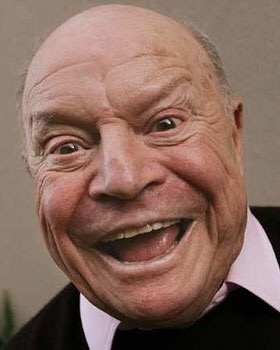
“So they’re Don Rickles,” said The Wife earlier. “Everyone is thrilled to be insulted by them.”

Rickles has been a topic of conversation around our house since his recent passing (I’m surprised I haven’t made her (re-)watch one of my beloved beach movies this week; they are for reasons Rickles and unRickles vital anthropological documents and I will never forsake them), so it’s no surprise that he came up. But I hadn’t thought of B&B in that way until she said something. We had noticed the theme in all the eulogizing by people both mentored and roasted by Rickles: everyone clearly loved and respected him in a deep and sincere way. At least the community he was a big part of certainly did.

And I think she hit on an important way to highlight the differences between the respective Mature Couples in Shrew and Ado: how they are received. B&B are constantly described as “merry” and no one says particularly unkind things about them on any subject except their mutual disdain for each other. Beatrice and her unstoppable Inner Groucho (a problem we share) don’t care what’s being talked about – wiseassery will be on offer. Benedicke’s modus operandi is Scorcesier…

(though that’s not the Scorcese I mean) …and was outlined by the oaf who wrote that “women can’t possibly understand Goodfellas” article a couple of years ago, to his eternal chagrin, I hope. His take on the movie was that of a person whose opinions are of little value, but he does manage to make one accurate diagnosis: busting each other’s chops is a particular feature of male relationships, in the English-speaking world, anyway. The military dudebros visiting Messina give each other hell constantly but don’t seem to mind and in fact egg each other on, until everything goes south when Don John ruins everything (though if the whole of the society we see wasn’t already solidly built from big dry chunks of misogyny he would have to do more than huff/puff to knock it all down; another post).

It will be on us to remember, therefore, while wiping K&P from our memory, that B&B like to crack wise but don’t really habitually belittle anyone but each other and even that is based in a mutual history, not disagreeableness. No one takes them terribly seriously or fears their wrath; they instead enjoy and encourage their wit. The heavy consequences in this play come from other quarters; these two just happen get wrapped up in them.

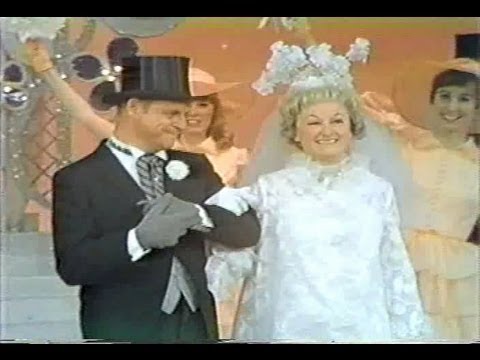
So that’s our plan. In the midst of a Regency-set Much Ado, we’re going to play Beatrice and Benedicke as Phyllis Diller and Don Rickles, wardrobe and all.* See you there.


* yes, you’re right, she would  have been a great Mistress Quickly, especially with that whole “Master Fang” business in 2 Henry IV.

The rarer action is/In virtue than in vengeance – TEMPEST, V i

This was all going to be a little bit silly, but it’s taken a turn. But let’s begin at the beginning.

A friend was in town a week or so ago for the Humana Festival at Actors Theatre of Louisville and conversation turned to Twelfth Night, a production of which he’s going to be involved in soon. My wife and I hadn’t seen him since the production we were in at the beginning of last year (which inspired the name of this ludicrous little blog), so there was much chatter, eventually turning to the whole “how dark does one play the ending, what with Malvolio being confined and confounded in a little room, do you reckon?” question, about which I have, as is my tendency, Opinions. They were gut opinions, but finally something occurred to me that I think backs them up.

I should first disclose that I am and have, at least since my university years, been sick of the Darkening of the Comedies.. This notion that the Tragedies are the real deal, the Histories are just Tragedies based on true stories (from which most comedy must be tainted/excised) and the Comedies, well, if they are anything but cheap crowd-pleasers, the Christmas Carols* of Shakespeare companies, at least we can overstate their existing darkness whenever possible, and maybe superimpose some extra for good measure, particularly at the very end when we have a chance to leave the audience with a sour stomach for one reason or another. It’ll let people know we’re Serious About All This.

And this was always treated as a profound thought from the Tragedians, worthy of congratulations or at least knowing nods above steepled fingers. “There’s such darkness in the Comedies, you know?” I was, as a lifelong lover of Chaplin’s movies about a starving homeless guy, the Marx Brothers’ insistent, destructive anarchy, the parentless Freudian head cases of Charles M. Schultz, confused. I thought that was the whole deal with comedy, that it Went On Despite, yes? So the battle between “Yes! I too have suffered!” and “Get over yourself; we’ve all suffered!”, between celebrating and mocking our mutual pain, is difficult to take part in when surrounded like the Light (Comedy) Brigade by people who sniff at your “glibness” if you aren’t constantly plunging yourself into the Cimmerian darkness of intangible despair. (That line is for my wife, who will appreciate it.)

But I digress.

We were talking about the end of Twelfth Night and how I fully believe that we aren’t supposed to mind Malvolio’s detention all that much because he is a petty, vindictive martinet with no trace of self-awareness. And I loved playing the guy. That old saw about having to like the character you’re playing in order to get under the skin is the true true; more accurately, you have to acknowledge that in some way you are the character in that in some way you are everybody, so there you are. We are all petty, vindictive martinets with little self-awareness at some time. I’ve been in traffic. And I’m not blind to the paragraphs above that are still unmercifully surly about mere aesthetic differences with people I’ve scarcely seen for twenty years. We’re all a bit Malvolic.

We most of us only suffer it in spells, though, and when Twelfth Night ends we leave Malvolio in the midst of being unmerciful, unforgiving, a crime that Shakespeare never lets slide:

Prospero? Stranded on an island for fifteen years by his brother. What does he do at the play’s end? Forgives him.

Who talks him into it? Ariel…who was enslaved by Prospero (and Sycorax and who knows who else before that). Ariel’s response, by all appearances, when released by Prospero? Forgives him.

Titus Andronicus? Nobody forgives nobody never. And everybody dies HORRIBLY, except the ones left behind to enact more revenge. We just run out of time to watch it all.

Duke Frederick of As You Like It? Random spiritual awakening, and he apologizes for everything – he only sends a note (“My bad; you can have all your stuff back”**), but he does it. No one says, “Not enough! Let’s storm the monastery and stab him!”

Hamlet? So bent on being vengeful that he opts out of killing Claudius in a private room where there’s only the two of them because that just might not condemn his soul to eternal hellfire. And what fun is that? So fifty-three other people have to die and a short-tempered cannon-feeding military dictator comes in to run the show thereafter. Good call.

There are others – Portia does a whole speech about this to Shylock you may have heard of – but that’s plenty.

And Malvolio decides to leave on the note of being “revenged on the whole pack of you”. So he gets what he gets. Which is probably, knowing Olivia, a generous severance package which he’ll still try to sue over because of some bonus he feels he’s owed over and above…somehow the lawyer he hires turns out to be a disguised Feste…it still ends badly. Because he’s a petty, vindictive martinet with no trace of self-awareness.

A detail that kind of slides by people: the whole reason Malvolio is released in Act V is to tell them what happened to the kind sea captain who still has Viola’s clothes; the helpful guy we haven’t seen since the first scene. Seems one of the reasons we haven’t seen him, thrown in as our last reminder of Malvolio’s consistent behavior, is that he was locked up (?!) by Malvolio for some reason no one is even sure of. But yes, let’s get all worried about Mal’s “pain & suffering”.

At any rate, Malvolio and the Maria/Toby/Feste/Fabian contingent are people we’d all rather watch bounce off each other than be around (have I mentioned that this is my favorite of Shakespeare’s plays?), but I can’t pretend any of them are serious offenders even of each other. They’re just childish people, in a turn-of-the-seventeenth-century-Seinfeld sort of way.

Now, how to put these feelings into performance? It isn’t terribly hard to make Malvolio an unrelenting pain in the ass simply by using the text. But some think the last bit of cruel wrongful incarceration on the part of Maria et al. is over the line. (I guess those folks don’t like sea captains.) I figured the best way to keep this in the realm of comedy (bending, not breaking) was to make it about injured pride, not utter madness, so the solution (at which I didn’t arrive until tech, which made me scare the hell out of the stage manager, to whom I apologized profusely) was to exit haughtily after the declaration of vengeance…and step right off the stage, entirely missing the steps into the vom, like an idiot. A couple of characters would snort, I would glare, straighten the skirts of my doublet and re-haughtify myself to exit again. It seemed to work, this gesture stolen directly from Rex Harrison, I later realized.

———

I decided to write all that this morning and had to do other things, but this topic keeps pitbulling the world today and just won’t unlock its jaws.

First we got word from a friend who was some time ago involved in a real, non-fictional tragedy. This friend was rattled after merely using the word “forgiveness” in discussing ways people have dealt with such tragedies in the past resulted in a verbal attack; apparently that vicious suggestion of “forgiveness” disrespects the grief of others…which, knowing this friend (and I’d have the same reaction) will be the cause of a roiling stomach precisely because of the evident pain of the person who decided to lash out at the suggestion of maintaining humanity in the face of tragedy, as if that suggestion was a mere passive/aggressive implication that said lasher-out hadn’t been forgiving enough. But I’m trying to universalize and instead I’m vaguebooking. Sorry.

Also, the verdict on the Charleston white-supremacy terrorist murders came down just a little while ago, which I am neither eloquent nor wise enough to try to summarize the facts of here, much less my own feelings, but there’s a conversation going on within many feeds and timelines and households and newsrooms right now about justice and forgiveness and how those things work.

And that conversation always brings me around to Ariel again, Ariel who (which?) is both non-human and fictional and who suggests that if Prospero were even to look upon the confusion he’s caused his enemies, “your affections/ Would become tender.” Prospero responds, “Dost thou thinke so, Spirit?”

And Ariel says (bearing in mind our distance from Jacobean spelling), “Mine would, Sir, were I humane.”

Usually this is modernized to “human” but it could still be “humane”. And ideally they’d be synonyms anyway.

All this makes Prospero realize that, as stated in this post’s title, “the rarer Action is/ In vertue, than in vengeance,” and it’s worth saying here that “rarer” in that era could be taken to mean not just uncommon, but also good, uncommonly good. Which is even better than humane***.

———

It’s been a long day; it’s been a long post. I am not a fan of his work, so my earlier plan was to quote Don Henley with ironic sarcasm and note that in trying to get down to the heart of the matter, I’ve reached the conclusion that I think it’s about forgiveness. Forgiveness.

But the world has blown my stock of irony today and I’d have to admit that the quotation works better without it and I’d just feel like a jerk. Not a Malvolio-level jerk, but still.

* I freaking love A Christmas Carol, for the record; it’s about generosity of spirit, which will be relevant shortly, if it can ever be said that it’s not relevant.

** paraphrase

*** tonally this is a weird place to note that today, 10 April 2017, is the incept date of replicant Leon Kowalski in Blade Runner. There’s an Ariel/Caliban streak in the replicants, but that’s probably obvious enough not to require a whole post. #MoreHumaneThanHumane