I yield upon great persuasion – MUCH ADO ABOUT NOTHING, V iv

All due Nerd Alerts and apologies, if such are necessary by now.

This production of Much Ado About Nothing that’s happening at Kentucky Shakespeare is set (roughly) during the Regency period, with allowances for the fact that a) Messina is in Italy and b) we’re in the business of popular theater, not rigorous Historical Recreation. The most important reasons for this setting are the obvious parallels to be drawn, noticed by even mildly attentive folks long before this production, between this particular play and multiple works of Jane Austen.

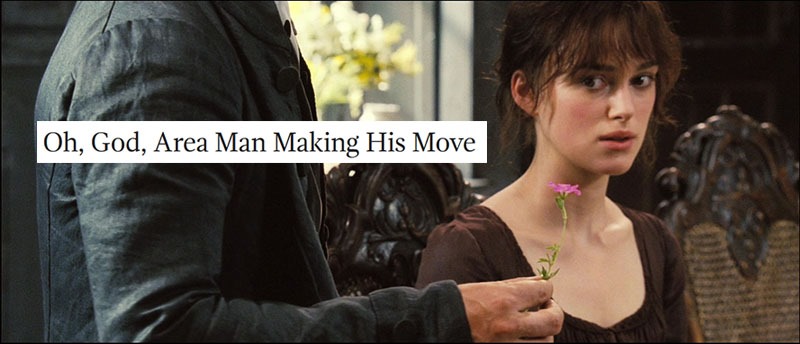
The obvious hook here is Pride and Prejudice, what with the saucy woman of intelligence, impatient with her lot in a Man’s World*, and her public war of words with a haughty man who shows no interest in her despite the obviousness (to us) that they will end up together forever OTP shippity ship ship insert tumblr meme here.
tumblr_nqs1z0L0hd1r8gvzro6_1280

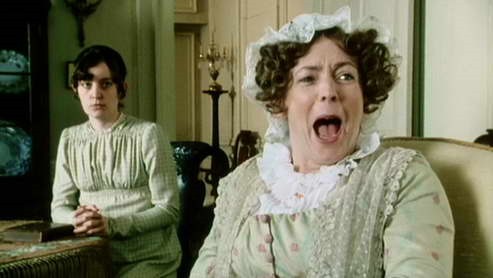
I’m going to presume your familiarity with P&P as it’s a difficult piece of popular culture to avoid, with or without the zombies. And it’s equally difficult while in the midst of a production of Much Ado not to find similarities ranging from the obvious (the romantic naïvete of Claudio Bingley & Jane Hero, Benedick’s list of necessary female qualities that is so close to Darcy’s it’s only a “pair of fine eyes” short of a direct quote, a nice mid-contra-dance spat) to the more esoteric – for example, I’m pretty sure the true Darcy personality analog is Don John and not Benedick; Benedick is a Wickham if ever there was one, in public at least, the private behavior of Wickham being the purview of Borachio instead. Austen just swapped their places in the structure of the story – true to form, it’s the men Austen finds interchangeable (Don John as he is would probably be at least as at home in Northanger Abbey as he is in Shakespeare) and makes almost tangential, just problems to be dealt with by the women, to whom she gives a society and inner life of their own. Take Leonato’s wife, Innogen (if you can find  her), a character that appears in a stage direction and a half and is given a name (barely) but no lines. Our knowledge of her existence seems purely due to an early draft in which no one got around to scratching her name out. I like to think of Mrs. Bennet as Jane’s Revenge for this oversight, a double verbosity to balance a muteness.
P&P 1995 mrs bennet

Abigail and I, in working on Bea & Ben’s scenes also noticed strong ties between the whole Kill Claudio business (if you’re reading this before you’ve watched our second half, spoiler alert) and the Vacationing Lizzie Tells Darcy About Lydia & Thinks He’s Skipping Town Because of It Which He Is But Not the Way She Thinks scene.** There are differences between the situations of the two women’s shamed relatives and between the types of dutiful feeling that spur the two men into action (Benedick loves Claudio and Darcy loathes Wickham, for starters), but the similarities are so clear that it feels wasteful to go into more detail.

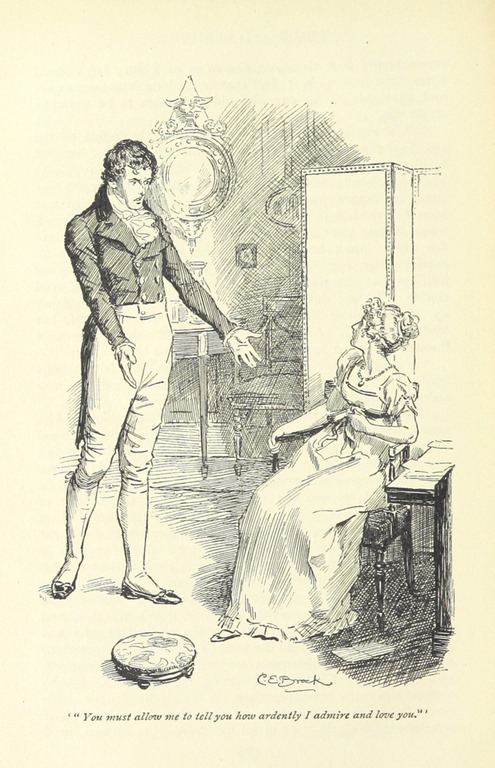
Also notable to us were the equally quotable direct-yet-confusing declarations of love – what is “You must allow me to tell you how ardently I admire and love you”, followed by details of Darcy’s sense of the general Bennet inferiority if not a one-page restating of Benedick’s single sentence “I do love nothing in the world so well as you; is not that strange?” And towards the end, note Lizzie’s “Now be sincere; did you admire me for my impertinence?” when laid alongside Beatrice’s “For which of my good parts did you first suffer love for me?” This isn’t brain surgery, but neither is it coincidence.
pride-and-prejudice-3

But to me, while the comedy angle of the Beatrice and Benedick plot (minus the elements of farce Jane disposes of) takes place very nicely alongside P&P, an important part of Much Ado also bears a strong resemblance to Persuasion, in that our pair of inevitables have some sort of history together that took a bad turn before the story begins and will need to be righted before it can end. Also, the word “prejudice” appears nowhere in the play – though in her snappy little soliloquy after she’s tricked into belief in Benedick’s lovesickness, Beatrice does come forth with “Stand I condemn’d for pride and scorn so much?/ Contempt, farewell, and maiden pride, adieu” which is really pretty close, sensewise – but there’s “persuasion” right in Beatrice’s final line (as noted in the title of this post). I’ve left out Mansfield Park, but it gives off more of a King-Lear-meets-All’s-Well vibe. Hamlet is read aloud in Sense & Sensibility, which must count for something.

On the subject of Emma, however, Shakespeare remains silent. Unless she’s Puck… Maybe some other season.

laurence-olivier-and-greer-garson-in-pride-and-prejudice-1940-large-picture


* It could be argued that this wasn’t really Austen’s focus, but it’s certainly an aspect that registers significantly now.

** I turned to my lovely wife for many of the Austenian particulars in this post; I enjoy those six novels greatly (and I also recommend Love & Friendship, Whit Stillman’s adapted Lady Susan – the film is delightful and his modification of the book is doubly so) and am an avid and unashamed watcher of any nine-hour BBC whispers-and-corsetry melodrama, but Abigail is fleeter than Google when you need a quote or a scene location from P&P. Ponder for a moment how many novels you can readily quote from if you’re a normal person whose job doesn’t require it. Not that she’s a normal person…

…an improbable fiction – TWELFTH NIGHT, III iv

All three shows in this summer’s season of Kentucky Shakespeare feature one of those little moments I love, which keep us (the show-makers) from getting too precious about ourselves. Shakespeare loves to throw these in, but they’re not always there and I’m glad we have one in each of this year’s scripts.

That is to say: cheap and easy metatheatre, not of the more obvious and showier Hamlet/Midsummer lay-within-a-play type but rather that kind where a character says in so many words, “Huh; it’s almost like you people are watching a play right now or something…” and the audience says, “Yup.” No litcrit treatises required, just a pleasant but trippy little flash of the Droste effect.

The techniques of actors are mentioned when the conspirators meet in Julius Caesar and Brutus admonishes them not to look all dark and guilty about this (“good! – I swear! – good!”) project they’re about to embark on, lest someone catch on too soon:

          Let not our lookes put on our purposes,

          But beare it as our Roman Actors do,

          With untyr’d Spirits and formal Constancie,

“untyr’d” in this case playing with the obvious sense of “not tired” but also “undressed”, “not attired” (seeing as how the Frenchy word “costume” didn’t sneak across the Channel for another couple of hundred years and actors were still changing backstage in what they called a “tiring house”), which is gloriously tricky talk: don’t look guilty because a) that will blow the whole plan but also importantly b) what, when you strip everything away, do you have to look guilty about when our basic purpose is so gosh-darned pure? Oh, Brutus. Stoicism doesn’t mix well with your naïve grasp on human nature. Been there, pal.

But that’s less metatheatre than a useful simile. The fun bit comes right after the fun and difficult to stage stabby scene* when Cassius has the (purely genuine or meant to manipulate or both? Actor’s call) philosophical presence of mind to wonder:

                                       How many Ages hence

          Shall this our lofty Scene be acted over,

          In State unborne, and Accents yet unknowne?

Brutus picks up the thought:

          How many times shall Caesar bleed in Sport

          That now…lye along,

          No worthier than the dust?

And then Cassius chimes back in with one of the play’s many understatements of gross miscalculation:

          So oft as that shall be,

          So often shall the knot of us be called,

          The Men that gave their Country liberty.

The path of that thought gives the audience a nice trajectory from “You called it, Cassius” to “Cool; we’re watching that happen right now” to “But guys, that whole spin doesn’t really play out for you in the long run” (or, if the audience knows the play, even the incredibly short run).

Richard II is all about pageantry and a king who lives for it, but he doesn’t speak in theatrical terms as often as you’d think. The real meta moment comes just after his super-fancy deposition scene with the broken mirror and the “Ay, no, no, I” business and all kinds of melodrama, Richard being a terrific part to tear a cat in** – and the next scene starts with Richard’s uncle York telling his wife the story of Henry IV’s triumphant ride amongst the people and the way-less-triumphant Richard’s similar ride after him:

          As in a Theater, the eyes of Men,

          After a well grac’d Actor leaves the Stage,

          Are idlely bent on him that enters next,

          Thinking his prattle to be tedious,

which manages both to compare the less-popular Richard with the triumphant Henry, but also compare the scattered and about-to-be-quite-comic (at last – this play is sparse on the levity) actor playing York with the impressiveness of the big Richard set piece that preceded this little scene of would-be domesticity and boots. I laugh every time in rehearsal, and the actor playing York isn’t particularly playing it up. It’s just unavoidable.

There’s little of this in Much Ado, since the scenes in which Beatrice and Benedick are tricked into romance are so inherently theatrical it’s scarcely worth mentioning in great detail. But just in case you were nodding off, at the end of the fooling of Benedick, Don Pedro mentions it anyway:

          the sport will be, when they hold one an opinion of another’s dotage, and no such matter, that’s the Scene that I would see, which will be merely a dumb show…

“merely a dumb show” being an odd way to describe any scene between Beatrice and Benedick, who even for characters in Shakespeare are chatty (and prose-chatty at that which is harder to memorize than verse-chatty, believe you me). Perhaps he’s just thinking wishfully; perhaps, considering that the dumb show usually served as a prologue to the main action, that’s more what he’s going for. There are, as always, options.

As I said, I’m happy these little nuggets appear in each of the summer’s plays because I love to look for the little similarities in plays that weren’t chosen by that criteria. More connections will start popping up once we’re doing all three in rotation. They always do. Assuming there’s anything left of our minds to notice such things at that point…


*I’ll be Caska in ours and I’m looking forward to going in with the first poke, partially for Drama and partially because it’s only going to get harder to stage from there.

** that’s from Shakespeare…

for ALWAYS I am Caesar – JULIUS CAESAR, I ii

During the week of May 8-14, I:

-was a part of the first read-through of Kentucky Shakespeare’s impending summer togas-and-all Julius Caesar;

-saw Kentucky Shakespeare’s 90-minute outdoor spring touring modern dress production of Julius Caesar;

-saw Shakespeare Behind Bars’s annual production at Luther Luckett Correctional Facility, directed by the same director as the previous two. Did I mention it was Julius Caesar?

It’s fascinating to experience so many related-but-unrelated productions of the same story in such a short span, especially having connections with each. Obviously I’m in one of them. I did the 90-minute cutting for another. And I’ve seen I think seven performances by the men of Shakespeare Behind Bars – the work Matt Wallace does with them as facilitator of these productions (which is like directing but allows them to take over a lot of the heavy lifting, especially in letting the older hands help in making the newer members of the group learn the ropes) never ceases to move and amaze.

And by move, I don’t just mean emotionally – those guys do not waste time or air but hustle the show along at a pace and with a clarity that professionals should pay attention to – they worked from a very lightly trimmed script (I think Antony’s servant, Cicero & Caius Ligarius were the only real cuts) and came in at about two hours and five minutes including intermission. Ponder any production you’ve ever seen and do the math. And they didn’t rush. They just moved. Everyone knew what was being said and didn’t worry about showing off emotionally. There wasn’t time; too much stuff was happening.

The thing that’s especially impressive about these productions is that often performances of the sort of Shakespeare Behind Bars are purely art therapy, which is valuable enough on its own. But in the dozen years I’ve been able see these performances, I’ve seen so much growth among the men as performers as well. I’ve also had the benefit of conversation with many of them about Shakespeare and performance (and pretty much exclusively that) and let me assure you they know what they’re talking about when they talk about those things. I count them as some of the most rewarding conversations and audience experiences of my life.

The performers also have a real knack that I wish I could figure out how to transfer to pro productions, which is this perfect toggle between utter silliness in the parts that should be played for laughs and the heightened tragic or supernatural. Lucius’s borderline narcolepsy that bookends the appearance of Caesar’s ghost, for example – they proved it possible to make an audience spring from goofy to intense and then relieve them back into goofy, thereby landing in a nice median from which we could move into the next matters at hand. That sounds like a weirdly specific thing, but it is a constantly useful skill when dealing with Shakespeare.

The 90-minute tour I have to step back from complimenting because I had a hand in it and therefore it’s not my place, but I really dug the modern setting. Those can go up and down. I’ve probably said here before that I’m less interested in whether the production obeyed the tenets of presumed original historical Elizabethan practices or was devised by puppeteers through theatre games and more interested in whether it was good. This simple black-suits-&-political-posters version with only six actors worked really well. There was little effort to be on the nose about anything politically specific so much as just let it be, which is for the best. If one is determined to shoehorn in precise cultural translations, they had all better work and they had better line up parallel across the full board. This one kept it generally in the political sphere (because that’s where the story happens) without trying to make anyone too precisely represent any one modern situation.

The reading was fun if only because I got to wear my dramaturg hat as well as my bald actor pate.* And I’m Caska, which means a light and frothy second half as a couple of one-liner soldiers. It’s terrific, this relatively calm second act, and will be even better once the reality that is an Ohio Valley July sets in. You can sometimes gauge actors’ ages or experience purely by how they respond to the idea of reinstating or cutting lines. Especially in a rep company when you have a fun and chewy role in one show and a medium-to-small role in the others. All actors are Nick Bottom at heart, but there’s a time when even the theatrical ego takes a relieved back seat to mental and physical exhaustion.

Alright. Onward. The Bishop of Carlisle isn’t going to memorize himself.

* The reason there’s been precious little action on this blog of late comes down to that as well – rehearsals started May 1 and I’ve been here for every scene every day until yesterday. At some point I should probably get fully off book for Benedick (I’m THIS CLOSE**); Greene and the Bishop of Carlisle are less of a worry, since Richard II opens two weeks later and I have only about two pages worth of lines, all verse, to Benedick’s twenty-five of prose.

**Update: got it.

Avaunt, and quit my sight! – MACBETH, III iv

I have one measly day off.

I chose to ignore the citywide bacchanal that is the Kentucky Derby because I’m marshaling my energies. I read, there may have been some knitting, and I spent a fair amount of time planning the first session of this Shakespeare readers’ workshop/book club/thing I’m doing this week. We may have watched the entirety of Princess Leia’s Stolen Death Star Plans with our lunch. There was a cocktail, another thing, like free time, that will be scarce as the summer continues (for vocal protection).

At 8:00, The Bad and the Beautiful, which I haven’t seen in quite a while, came on TCM. It’s good (an Essential, even*), so I left it on. Shields (Kirk Douglas) comes to Georgia‘s (Lana Turner) apartment and finds out she’s daughter of a (dead) John Barrymore-esque actor he had known. He puts on a record of her father performing (voiced by Louis Calhern, which I just realized I should look up and check except I know that voice and have no need to confirm). He is of course performing Shakespeare. Because as I have noted time and time again, I am not allowed to escape.

Calhern is doing a gloriously orotund Macbeth, kicking in at “She should have died hereafter”, but then (because that’s what I’m listening to, of course, not the scene that’s happening on top of it) the audio loops back to an earlier bit from before Lady M.’s death with which I’m reasonably familiar. (My wife confirmed it, as she remembered hearing it while waiting to scream offstage when she played said Lady.)

But I decided not to let it ruin my night; simply to accept the inevitable. And keep watching, at least until Gloria Grahame’s part is finished.

I wouldn’t mention it here were it not the second time it’s happened this week.

Rehearsals started Monday, so we’re not in crazy crunch time like we’ll be in, oh, another week. So we thought we’d tick one off the DVR on, I forget, Tuesday or Wednesday. We watch a lot of Cagney and a lot of the sort of comedies of that era some call screwball, yet somehow neither of us had seen The Bride Came C.O.D.

It’s a so-so movie, mostly a rejuggling of It Happened One Night, but on a night off I ask little, just a dopey bit of escapism after a long day of acting (and dancing) Much Ado, and a few minutes in, on comes the manipulative radio announcer (Stuart Erwin) to report that “the musical world’s most eligible bachelor, Allen Brice, will tonight become a Benedict”.

Now, I ask you. This isn’t even a movie about actors where one might expect that sort of thing. Unfair. Badly done, DVR.

Back to work tomorrow. Heaven knows what will accost me in my three-week-old New Yorker on the bus.


* And full of great lines. “There are no great men, buster. There’s only men.” Also Gloria Grahame, for which I would watch and have watched nearly anything.

O if you raise this house against this house… RICHARD II, IV i

Something that’s been discussed as we begin this multi-season Henriad enterprise at Kentucky Shakespeare, with casting and design that carry over from production to production and year to year until we’re done or it kills us (it’s hot out there), is how to…not change anything about the plays themselves, exactly, but how to convince people that they are certainly no harder (and perhaps much easier) to follow than, say, Game of Thrones.

And yet when you mention Shakespeare’s Histories to even a fairly well-read person, there’s that tendency to recoil, as if the word “history” has already made things sound homeworky and antiseptic. Often the person will be able to bob and weave effortlessly through the subtle complexities of House Lannister or the cultural reasons for dwarf/elf antagonism in Middle Earth, but as soon as the names aren’t made up, they go cold as any stone. Never underestimate the educational incentives that are Boobs’n’Dragons, I guess.

I need to be clear here that I’m casting no aspersions – this is more of a marketing perplexity. I’m an avid watcher of Game of Thrones, a still-avid reader of Tolkien (though there is a point at which I don’t need to read every published napkin he scribbled on, Christopher). I’m working my way through Rothfuss, too, though I’m enjoying it enough that I’m intentionally making it last.

That’s a good example, in fact: the Kingkiller Chronicles have a distinctive world with distinctive rules, but they are being told to you as if you already knew those rules, which you then pick up by context and gradual revelation. And people love it because the writing is good. I don’t think I’m being excessive when I say it would be easy to write the same sentence about the Histories.

I wonder if it would help people to know the plays are wildly inaccurate. Maybe not wildly, but certainly…condensed & made more legendary than factual. Partially because you’re on dangerous ground when you start attaching motives to people whose Houses are still walking the streets and patronizing theater companies and beheading people. Partially because speculation is more interesting, even within those boundaries. Partially because of the bit of wisdom from John Ford (the filmmaker, not the Jacobean playwright – though cf. Angela Carter’s “John Ford’s ‘ ‘Tis Pity She’s A Whore’” which is a favorite of mine) regarding whether to print truth or legend (I’m betting both Fords would agree the latter).

In fairness, there are people you’re introduced to whose names you barely know and whose backstory you have to imagine, if you even care to; even a historian would have some trouble digging up useful information on some of the all-but-supernumeraries. But if you put this in a modern scenario, these would be the very characters making a living by making appearances at conventions populated by people who learn Klingon (and therefore can totally handle Elizabethan English). Signing autographs and obscure Kenner figures, taking photos with fans astounded to meet “one of the guys who drowns George, Duke of Clarence!!”

I’m trying to avoid bringing the Hollow Crown series into this so as to duck the inevitable flaming that would follow my true opinion, but suffice it to say that it is not the answer I’m looking for.

Anyway. I don’t have a conclusion to this ongoing process. I’m just musing as I type or vice versa. Fortunately, this is only Year One. We just have to convince audiences to see Richard II, which in this political climate should be a cinch.